
Meeting/Event Information
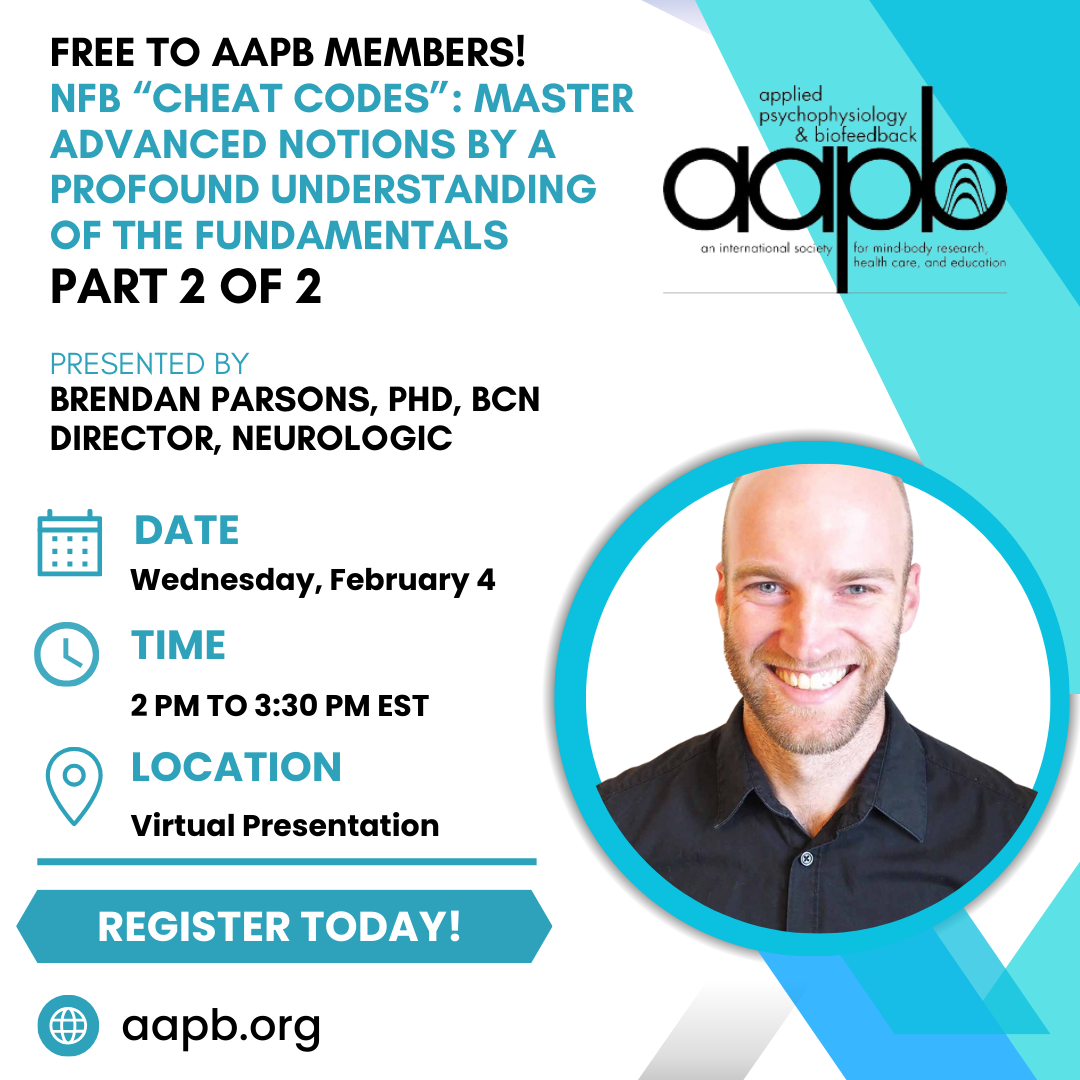
AAPB Virtual Education/PART 2: Neurofeedback “Cheat Codes”: Master Advanced Notions by a Profound Understanding of the Fundamentals
Date:
Part 2 of 2 - Wednesday, February 4, 2026
Time:
- 2 pm to 3:30 pm Eastern
- 1 pm to 2:30 pm Central
- 12 pm to 1:30 pm Mountain
- 11 am to 12:30 pm Pacific
CE Credits:
- PART 2: 1.5 CE Credits
Pricing:
AAPB Member and Student Member Price:
- PART 2: Complimentary
Non Member Price:
- PART 2: $95 through January 21, 2026; $125 after
Non Member Student Price:
- PART 2: $65 through January 21, 2026; $75 after
About This Presentation:
Neurofeedback stands at the cutting edge of modern intervention methods, weaving together neuroimaging, advanced technology, and an array of therapeutic and coaching strategies. Despite being a field underpinned by scientific rigor—boasting over 3,000 peer-reviewed studies—it's often regarded by practitioners as having an 'artistic' aspect. This creativity is particularly evident in the crafting of qEEG-informed protocols and their implementation in a clinical context. It's well understood among professionals that neurofeedback is not as straightforward as merely setting a threshold to "inhibit theta" and then relaxing with a cup of coffee. Instead, neurofeedback involves a complex interaction between three key elements: the trainee (encompassing both their brain and mind), the trainer, and the feedback system. The art lies in fine-tuning this triad to unlock the most effective intervention and achieve positive outcomes. "With nearly two decades of experience, he has had the privilege of both learning from leading experts around the world and directly applying this knowledge through extensive hands-on practice. Dr. Parsons' journey has encompassed analyzing over 50,000 qEEGs, conducting 10,000 neurofeedback sessions personally, and overseeing another 100,000 sessions through direct supervision. He has had the pleasure of accompanying some afflicted by a severe neurological disorder all the way to world-class professional athletes. His approach doesn't seek to reinvent neurofeedback; instead, it aims to distill it into its most fundamental principles, grounded in well-established scientific evidence.
Part 2 will focus on:
- 4. Developing a personalized qEEG protocol
- 5. Maximizing the efficiency of training
About Our Presenter:
Brendan Parsons, MSc, PhD, BCN, is an expert in neurofeedback and biofeedback with nearly 20 years of experience. Holding a Ph.D. in neuropsychology, he specializes in clinical applications, athletic performance (e.g., NHL and Olympic athletes), and business leadership. Certified BCN since 2009, Brendan has advanced qEEG interpretation, contributed to peer-reviewed research, and developed evidence-based methods for clinical practice. Co-founder of NeuroLogic, he also pioneered French-language BCIA-certified neurofeedback training in France. Brendan teaches professionals globally and is dedicated to helping integrate evidence-based neurofeedback techniques into diverse fields of practice.
Learning Objectives:
- Develop and validate empirically-based qEEG-informed protocols, blending the artistic aspects of neurofeedback with solid scientific evidence.
- Promote Effective Transfer: Maximize the specific effects of neurofeedback while ethically enhancing the non-specific effects to ensure a comprehensive impact on client well-being.
- Utilize proven strategies grounded in the fundamental principles of neuroplasticity to optimize client outcomes, emphasizing the critical interaction between the trainee, the trainer, and the feedback system
- Describe how a deep grasp of foundational concepts can lead to innovative solutions and improved outcomes in clinical neurofeedback practice.
- Develop the ability to critically evaluate and adapt neurofeedback protocols in real-time, leveraging a profound understanding of core principles and clinical experience to address diverse client needs effectively.
Level:
Intermediate
Content builds upon the learner's foundational knowledge, familiarity with the literature and/or experience in a content area. Programming at this level includes more depth than at a beginning level program. It could also serve as a refresher course for individuals who have a background in a content area and are interested in learning more contemporary applications.
For those psychologists using the modality of biofeedback and interested in efficacy, science, and latest clinical applications. This session (1) presents research relevant to psychological practice, education, and science; (2) it is our intention to host an offering to help psychologists to keep up with the most current scientific evidence regarding assessment, intervention, and education; and (3) we believe that this program would allow psychologists to increase competencies in order to improve services to patients. This presentation is IN NO WAY a substitute for the basic academic education and training needed for entry into the field of psychology.
Target Audience Description (who should attend):
Neurofeedback professionals in active practice, biofeedback professionals looking to add neurofeedback to their clinical tools
Content Balance:
60% Clinical/40% Research
Disclosure:
Our presenter has financial interest to disclose. Dr. Parsons is the Director of NeuroLogic. NeuroLogic provides neurofeedback education and services. This presentation will be free of commercial bias.
Utility/Validity:
The methods outlined in this program are intended for educational purposes. Our presenter advocates for the application of these evidence-based therapeutic strategies, it's important to recognize that various factors could influence the outcomes when these approaches are implemented in clinical practice.
Diversity:
Neurofeedback protocols must be tailored to the individual as well as their specific context. This adaptation requires addressing diversity as it manifests in a clinical setting.
References:
- Kvamme, T. L., Ros, T., & Overgaard, M. (2022). Can neurofeedback provide evidence of direct brain-behavior causality?. Neuroimage, 258, 119400. https://doi.org/10.1016/j.neuroimage.2022.119400
- Radua, J., Stoica, T., Scheinost, D., Pittenger, C., & Hampson, M. (2018). Neural correlates of success and failure signals during neurofeedback learning. Neuroscience, 378, 11-21. https://doi.org/10.1016/j.neuroscience.2016.04.003
- Muñoz-Moldes, S., & Cleeremans, A. (2020). Delineating implicit and explicit processes in neurofeedback learning. Neuroscience & Biobehavioral Reviews, 118, 681-688. https://doi.org/10.1016/j.neubiorev.2020.09.003
- Weber, L. A., Ethofer, T., & Ehlis, A. C. (2020). Predictors of neurofeedback training outcome: A systematic review. NeuroImage: Clinical, 27, 102301. https://www.sciencedirect.com/science/article/pii/S2213158220301388
- Kleim, J. A., & Jones, T. A. (2008). Principles of experience-dependent neural plasticity: implications for rehabilitation after brain damage. http://bridgesnky.org/uploads/2016_Experience-Dependent_Neuroplasticity.pdf
GAP Correction:
The presentation addresses the practice “gap” in neurofeedback by translating nearly two decades of clinical expertise and extensive data analysis into actionable strategies for practitioners. By focusing on the interplay of evidence-based qEEG-informed protocols and the nuanced “art” of neurofeedback, this presentation enhances competency by equipping attendees with robust scientific principles and advanced techniques. Participants will learn to optimize the triad of trainee, trainer, and feedback system, bridging the gap between theoretical knowledge and practical application. This strengthens performance by empowering practitioners to refine decision-making, adapt protocols effectively, and maximize both specific and non-specific effects of neurofeedback. Finally, the emphasis on individualized and empirically supported approaches directly improves patient outcomes. Through better protocol design, enhanced clinical innovation, and a deep understanding of neuroplasticity, attendees will be better equipped to deliver interventions that are not only scientifically validated but also tailored to achieve meaningful and lasting improvements in client well-being. This ensures that the knowledge translated in the session leads to tangible improvements in the delivery of health services.
Delivery Method:
Zoom Platform - virtual attendance only
CONTINUING EDUCATION STATEMENTS

Psychologists: The Association for Applied Psychophysiology and Biofeedback is approved by the American Psychological Association to sponsor continuing education for psychologists. The Association for Applied Psychophysiology and Biofeedback maintains responsibility for the program and its content.
Part 1 and Part 2 of this session offer a MAXIMUM of 1.5 CE credits per each session for maximum participation. A total of 3.0 CE credits may be earned for full participation this series.
BCIA Recertification: Hour-for-hour attendance may be used to fulfill the continuing education requirements for recertification with certificate of attendance.
About Continuing Education: Coverage & Reciprocity
Psychologists (APA) Coverage & Reciprocity
The following state boards accept courses from APA providers for Counselors: AK, AL, AR, AZ, CA, CO, CT, DC, DE, FL, GA, HI, IA, ID, IL, IN, KS, KY, MD, ME, MO, NC, ND, NH, NE, NJ, NM, NV, OK*, OR, PA, RI, SC, SD, TN, TX, UT, VA, WI, WY
MI: No CE requirements
The following state boards accept courses from APA providers for MFTs: AK, AR, AZ, CA, CO, CT, DE, FL, GA, IA, ID, IN, KS, MD, ME, MO, NE, NC, NH, NJ, NM, NV, OK*, OR, PA, RI, SC, SD, TN, TX, UT, VA, WA, WI, WY
The following state boards accept courses from APA providers for Addictions Professionals: AK, AR, CO, CT, DC, DE, GA, IA, IN, KS, LA, MD, MO, MT, NC, ND, NE, NJ, NM, NY (outstate held), OK*, OR, SC, UT, WA, WI, WY
* OK accepts APA credit for live, in-person activities. For all ethics and/or online courses, an application is required.
MA / MFTs: Participants can self-submit courses not approved by the MAMFT board for review.
The following state boards accept courses from APA providers for Social Workers: AK, AR, AZ, CA, CO, DE, FL, GA, ID, IN, KY, ME, MN, MO, NE, NH, NM, OR, PA, VT, WI, WY
IMPORTANT NOTICE: Those who attend this event in full and complete the appropriate evaluation form will receive CE credits. Those arriving more than 15 minutes after the start time or leaving before a given activity is completed will not receive CE credit.
Cancellation Policy (PART 1): Cancellations received by the AAPB office by January 14, 2026 will be refunded minus a $50 processing fee. NO REFUNDS WILL BE GRANTED AFTER January 14, 2026. Cancellations must be made in writing and emailed to [email protected]. Fees cannot be refunded for registrations cancelled after the presentation begins.
Grievance Policy: The Association of Applied Psychophysiology and Biofeedback (AAPB) is fully committed to conducting all activities in strict conformance with the American Psychological Association's Ethical Principles of Psychologists. AAPB will comply with all legal and ethical responsibilities to be non-discriminatory in promotional activities, program content and in the treatment of program participants. The monitoring and assessment of compliance with these standards will be the responsibility of the Education Chair in consultation with the members of the continuing education committee, the AAPB Ethics Chairperson, Continuing Education (CE) Committee Chairperson, Program Planning Committee Chairperson, and/or the Conference Chairperson. While AAPB goes to great lengths to assure fair treatment for all participants and attempts to anticipate problems, there will be occasional issues which come to the attention of the convention staff which require intervention and/or action on the part of the convention staff or an officer of AAPB. This procedural description serves as a guideline for handling such grievances. 1. When a participant, either orally or in written format, files a grievance and expects action on the complaint, the following actions will be taken. If the person toward whom the grievance is directed is also the instructor or a chair of any of the above-mentioned committees, the AAPB Board of Directors will appoint a Board representative to oversee the resolution of any of the participant complaints, in an effort to avoid any and all conflicts of interest. If the grievance concerns a speaker, the content presented by the speaker, or the style of presentation, the individual filing the grievance will be asked to put his/her comments in written format. The CE Chair will then pass on the comments to the speaker, assuring the confidentiality of the grieved individual. 2. If the grievance concerns a workshop offering, its content, level of presentation, or the facilities in which the workshop was offered, the convention chair will mediate and will be the final arbitrator. If the participant requests action, the convention chair will: a) attempt to move the participant to another workshop or b) provide a credit for a subsequent year's workshop or c) provide a partial or full refund of the workshop fee. Actions 2b and 2c will require a written note, documenting the grievance, for record keeping purposes. The note need not be signed by the grieved individual. 3. If the grievance concerns an AAPB CE program, in a specific regard, the CE Chair will attempt to arbitrate.
Contact name(s)*: Leslie Shivers, AAPB Executive Director
Email: [email protected]
Telephone: 800-477-8892 or +1 303-422-8436
Address: PO Box 461797, Aurora, CO 80046-1797
Tickets
$0.00 Member ticket
$95.00 Non-member ticket
$125.00 after 12:00 am January 22
$65.00 Non-Member Student Ticket
$75.00 after 12:00 am January 22
