
Meeting/Event Information
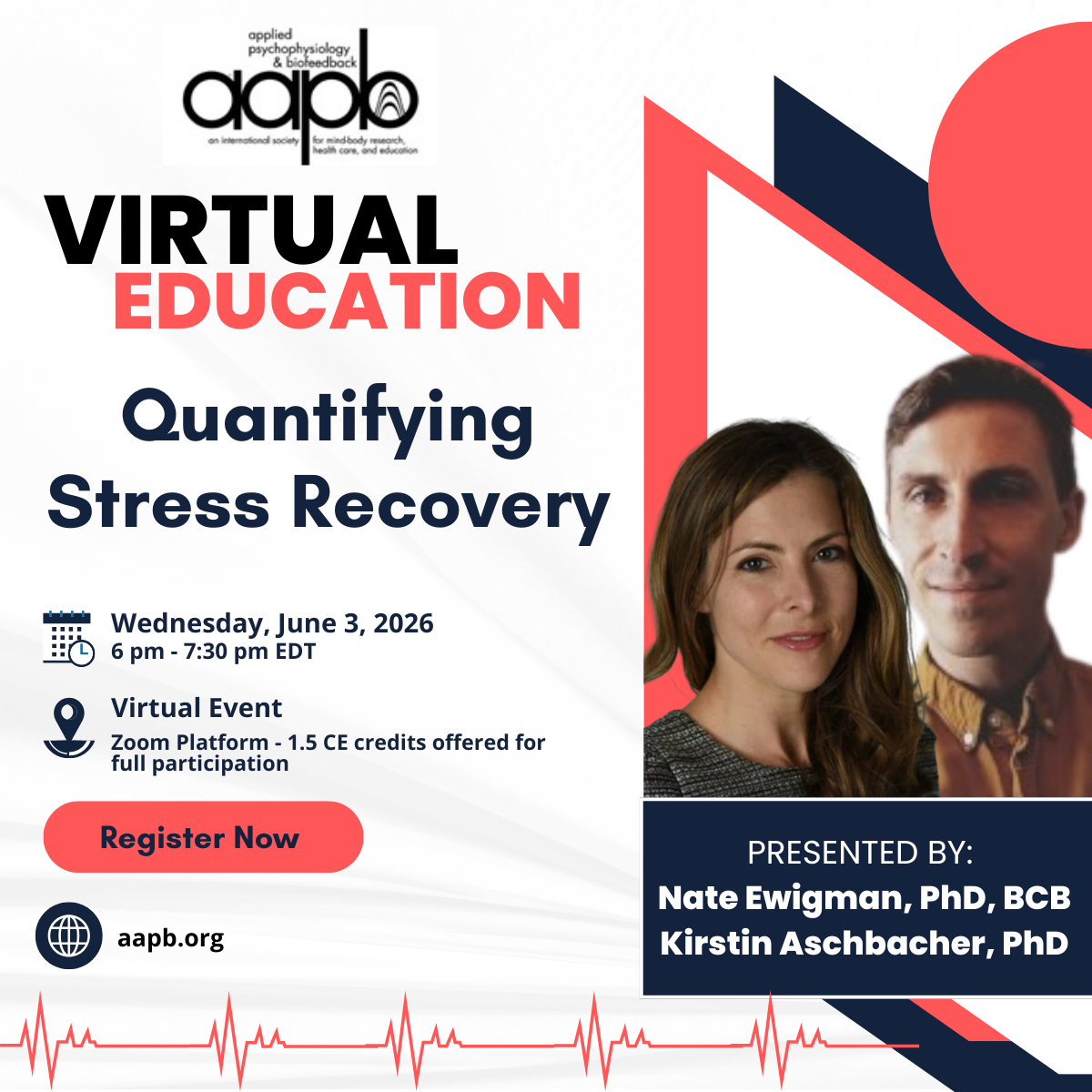
AAPB Virtual Education: Quantifying Stress Recovery
Date/Time:
Wednesday, June 3, 2026
- 6:00 pm to 7:30 pm EDT
- 5:00 pm to 6:30 pm CDT
- 4:00 pm to 5:30 pm MDT
- 3:00 pm to 4:30 pm PDT
About this Presentation
Effective psychophysiological stress assessment requires capturing both reactivity and recovery across physiological systems. We introduce a Stress Recovery Score (SRS) derived from multi-modal stress profiles, including HR, HRV, SC, finger temperature, EMG, and respiratory measures. The SRS distinguishes maladaptive stress kindling—responses that fail to recover—from healthy stress recovery patterns. It is modeled using mechanism-specific recovery metrics: sympathetic (SC, temperature) slope and time to baseline; vagal (HR, HRV) percent recovery; somatic (EMG) tension return; and respiratory/chemical setpoint restoration. The SRS can be used both as a composite measure and grouped by physiology and stressor type,providing a nuanced, individualized measure of stress response patterns and a quantified index of treatment progress. During this presentation, the presenters will share how to input de-identified stress profile data to automatically generate SRS values
CE Credits
1.5 CE credits available for full event participation. You must attend the full, live delivery of the presentation to qualify for CE Credits.
Learning Objectives
As a result of this presentation, you will learn to:
- Identify stress kindling & stress recovery across physiological measures
- List the physiological systems used to model the Stress Recovery Score (SRS), including sympathetic, vagal, somatic, and respiratory/chemical measures
- Summarize research that support the authors' operationalization of stress recovery by physiology modality
- Discuss ways in which a Stress Recovery Score could be used to aid clinical conceptualization and treatment planning
- Select the most important Stress Recovery Scores to share with patients depending on clinical presentation
Target Audience
Biofeedback clinicians who assess stress reactivity & recovery. Researchers interested in stress recovery
Level
Advanced
Builds upon established experience, knowledge, and skills in the content area. This may include more diverse applications to specific populations, or a novel application of the skill presented. Advanced level programming tends to be more specialized in nature and allows the learner to integrate and enhance knowledge and skills into their practice or other professional domains.
For those psychologists using the modality of biofeedback and interested in efficacy, science, and latest clinical applications. This conference (1) presents research relevant to psychological practice, education, and science; (2) it is our intention to host an offering to help psychologists to keep up with the most current scientific evidence regarding assessment, intervention, and education; and (3) we believe that this program would allow psychologists to increase competencies in order to improve services to patients. This conference is IN NO WAY a substitute for the basic academic education and training needed for entry into the field of psychology.
Utility and Validity (Risks)
Adding a score to a stress profile assessment is unlikely to introduce clinical risk. However, using this score without expertise in psychophysiological assessment would be inappropriate, and over-interpreting its generalizability should be avoided to maximize its benefit.
DEIJ Considerations
Offering a model that quantifies stress kindling and recovery creates opportunities for research stratifying recovery patterns across populations exposed to different societal stressors and power structures.
References
Degering, M., Linz, R., Puhlmann, L. M., Singer, T., & Engert, V. (2023). Revisiting the stress recovery hypothesis: Differential associations of cortisol stress reactivity and recovery after acute psychosocial stress with markers of long-term stress and health. Brain, Behavior, & Immunity – Health, 28, 100598.
Kim, H.-G., Cheon, E.-J., Bai, D.-S., Lee, Y.-H., & Koo, B.-H. (2018). Stress and heart rate variability: A meta-analysis and review of the literature. Psychiatry Investigation, 15(3).
Diaz-Ramos, R. E., Gomez-Cravioto, D. A., Trejo, L. A., López, C. F., & Medina-Pérez, M. A. (2021). Towards a resilience to stress index based on physiological response: A machine learning approach. Sensors, 21(24), 8293.
Ernst, H., Scherpf, M., Pannasch, S., Helmert, J. R., Malberg, H., & Schmidt, M. (2023). Assessment of the human response to acute mental stress – an overview and a multimodal study. PLOS ONE, 18(11), e0294069.
Roddick, T., Kandasamy, Y., Mulé, M., & Blanchard, D. C. (2025). Cardiac vagal recovery following acute psychological stress in human adults: A scoping review. Journal of Psychophysiology.
Pricing
- AAPB Member and Student Member Price: $45 through May 20; $60 after
- Non-member Price: $85 through May 20; $100 after
- Non-member Student Price: $65 through May 20; $70 after
About Our Presenters
Nate Ewigman, PhD, BCB, Clinical Psychologist / Private Practice
Nate Ewigman is a licensed clinical health psychologist in California, practicing privately and specializing in the integration of biofeedback with evidence-based psychotherapies to improve top-down cognitive and emotional responding. In addition to direct patient care, he enjoys writing, mentoring, and teaching about biofeedback and mindfulness-based therapeutic approaches. His primary professional obsession is understanding how psychophysiology can advance clinical models of stress recovery, with the ultimate goal of promoting skillful and ethical responsivity.
Dr. Nate Ewigman has no financial interests to disclose.
Kirstin Aschbacher, PhD, Clinical Psychologist / AI Consultant
Dr. Aschbacher is a clinical scientist, licensed psychologist, and AI/ML consultant with over 15 years of experience integrating computational modeling, biofeedback, and psychophysiological signal analysis into clinical and digital health applications. Her background bridges psychiatry, cardiology, and data science, including prior roles as an Associate Professor at UCSF and Senior Director of Data Science at Meru Health. Her current consulting practice focuses on developing and validating machine learning models that integrate cardiovascular and neural signals with patient narrative descriptions to improve psychotherapy and behavioral health interventions. Dr. Aschbacher specializes in HRV biofeedback, psychophysiological monitoring, and AI algorithm design for stress-related disorders and cardiometabolic health. Her prior NIH-funded work and leadership in digital mental health algorithm development supports her commitment to advancing precision care through ethically aligned and explainable AI systems.
Dr. Kirstin Aschbacher has financial interests to disclose. She is the owner and Principal Consultant of Health and Wellness Consulting LLC and has provided paid consulting services to SandboxAQ, IMBR.org (fractional CAIO), Philia Health, and BetterMe. The findings presented in this conference are not directly related to her work performed for these companies, but instead reflect work performed outside of those relationships. She may benefit financially as a result of research findings presented herein.
This presentation will be free of commercial bias.
Delivery Method
CONTINUING EDUCATION STATEMENTS

IMPORTANT NOTICE: Those who attend this event in full and complete the appropriate evaluation form will receive CE credits. Those arriving more than 15 minutes after the start time or leaving before a given activity is completed will not receive CE credit.
Cancellation Policy: Cancellations received by the AAPB office by ten days prior to event will be refunded minus a $25 processing fee. NO REFUNDS WILL BE GRANTED WITHIN TEN DAYS of the event. Cancellations must be made in writing and emailed to [email protected]. Fees cannot be refunded for registrations cancelled after the presentation begins.
Grievance Policy: The Association of Applied Psychophysiology and Biofeedback (AAPB) is fully committed to conducting all activities in strict conformance with the American Psychological Association's Ethical Principles of Psychologists. AAPB will comply with all legal and ethical responsibilities to be non-discriminatory in promotional activities, program content and in the treatment of program participants. The monitoring and assessment of compliance with these standards will be the responsibility of the Education Chair in consultation with the members of the continuing education committee, the AAPB Ethics Chairperson, Continuing Education (CE) Committee Chairperson, Program Planning Committee Chairperson, and/or the Conference Chairperson. While AAPB goes to great lengths to assure fair treatment for all participants and attempts to anticipate problems, there will be occasional issues which come to the attention of the convention staff which require intervention and/or action on the part of the convention staff or an officer of AAPB. This procedural description serves as a guideline for handling such grievances. 1. When a participant, either orally or in written format, files a grievance and expects action on the complaint, the following actions will be taken. If the person toward whom the grievance is directed is also the instructor or a chair of any of the above-mentioned committees, the AAPB Board of Directors will appoint a Board representative to oversee the resolution of any of the participant complaints, in an effort to avoid any and all conflicts of interest. If the grievance concerns a speaker, the content presented by the speaker, or the style of presentation, the individual filing the grievance will be asked to put his/her comments in written format. The CE Chair will then pass on the comments to the speaker, assuring the confidentiality of the grieved individual. 2. If the grievance concerns a workshop offering, its content, level of presentation, or the facilities in which the workshop was offered, the convention chair will mediate and will be the final arbitrator. If the participant requests action, the convention chair will: a) attempt to move the participant to another workshop or b) provide a credit for a subsequent year's workshop or c) provide a partial or full refund of the workshop fee. Actions 2b and 2c will require a written note, documenting the grievance, for record keeping purposes. The note need not be signed by the grieved individual. 3. If the grievance concerns an AAPB CE program, in a specific regard, the CE Chair will attempt to arbitrate.
Contact name(s)*: Leslie Shivers, AAPB Executive Director
Email: [email protected]
Telephone: 800-477-8892 or +1 303-422-8436
Address: PO Box 461797, Aurora, CO 80046-1797
Tickets
$45.00 Member ticket
$60.00 after 12:00 am May 21
$85.00 Non-member ticket
$100.00 after 12:00 am May 21
$65.00 Non-member Student Ticket
$70.00 after 12:00 am May 21
