
Meeting/Event Information
AAPB Virtual Education: Biofeedback Enhanced Stress Resilience Training: Transforming stress into positive energy, positive mental focus, and positive mood
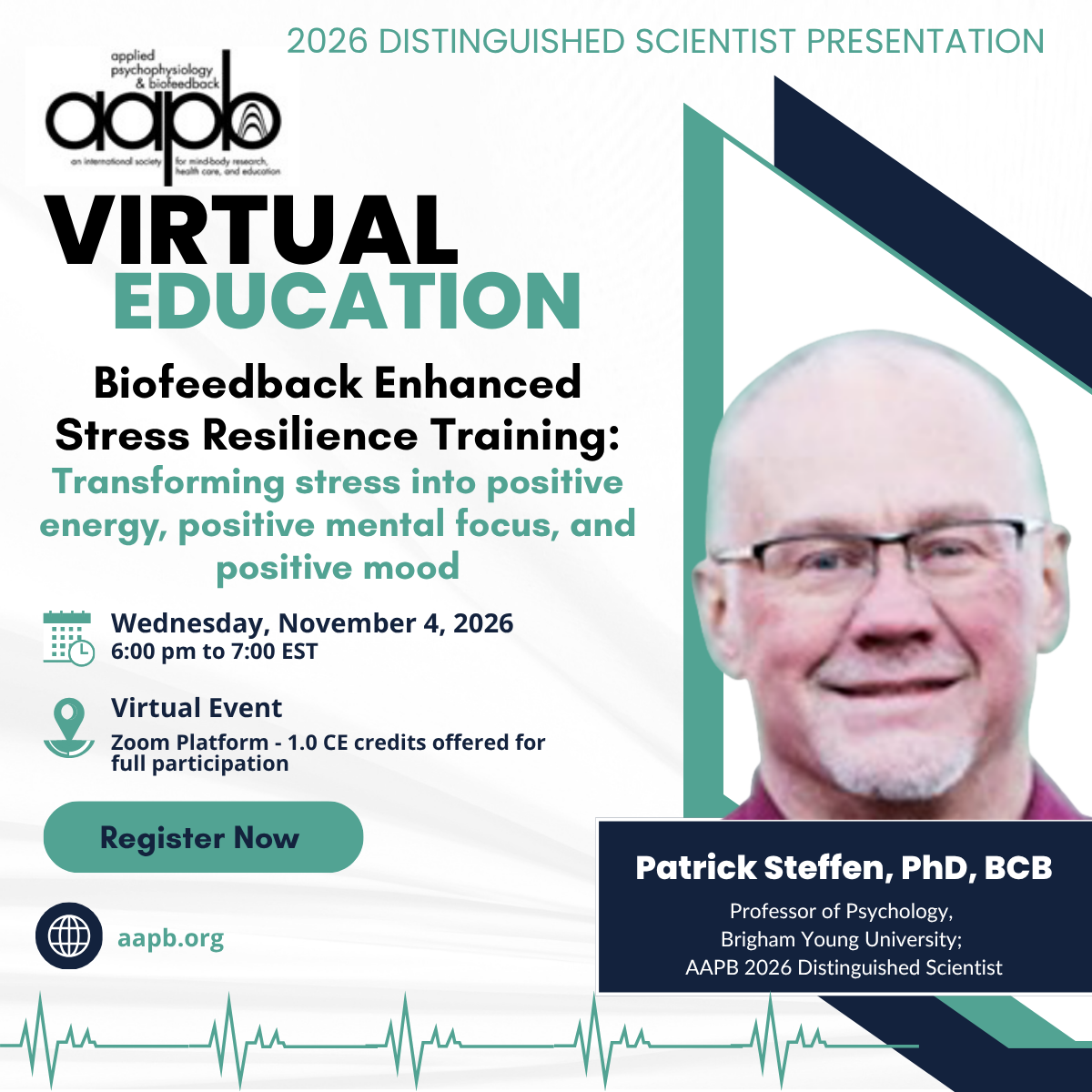
Date/Time:
Wednesday, November 4, 2026
- 6:00 pm to 7:00 pm EST
- 5:00 pm to 6:00 pm CST
- 4:00 pm to 5:00 pm MST
- 3:00 pm to 4:00 pm PST
About this Presentation
Biofeedback Enhanced Stress Resilience Training (BE-SRT) is an evidence-based intervention designed to transform stress into positive energy, positive mood, and positive mental focus. BE-SRT involves 3 phases: First, building resilient self-regulation by learning to regulate our stress response using heart rate variability (HRV) biofeedback; second, building resilient focus by narrowing our focus to what matters most and eliminating unnecessary stress by identifying personal life values and personality strengths; and third developing resilient capacity by building resilient bodies (sleep, activity, diet), resilient minds (positive life narrative), and resilient relationships (interpersonal skills). Integrating principles from empirically validated approaches such as heart rate variability (HRV) biofeedback, Behavioral Activation, Cognitive and Interpersonal Therapy, and Acceptance and Commitment Therapy, BE-SRT provides the most comprehensive intervention for improving stress resilience.
CE Credits
1.0 CE credit available for full event participation. You must attend the full, live delivery of the presentation to qualify for CE Credits.
Learning Objectives
As a result of this presentation, you will learn to:
-
List key features of the stress response
-
Explain how biofeedback fits within a broader stress management approach
-
Discuss how personal values and valued action help people to eliminate unnecessary stress by focusing on what matters most, and how this can fit within a biofeedback framework
-
Target Audience
Those interested in approaches to integrating biofeedback with stress management or psychotherapy
Level
Introductory
Content is designed for psychologists who may have little to no background in a specialized skill or content area. Through this level of programming, the learner can become acquainted with the theoretical underpinnings, principles, methods, and perspectives of a content area. An introductory level program also may serve as the foundation for subsequent intermediate and advanced learning. Introductory level programming may also be related to an emerging area of knowledge or practice. Although this content can be used as a foundation for more advanced learning, an introductory level program may simply focus on breadth, enrichment or general knowledge.
For those psychologists using the modality of biofeedback and interested in efficacy, science, and latest clinical applications. This conference (1) presents research relevant to psychological practice, education, and science; (2) it is our intention to host an offering to help psychologists to keep up with the most current scientific evidence regarding assessment, intervention, and education; and (3) we believe that this program would allow psychologists to increase competencies in order to improve services to patients. This conference is IN NO WAY a substitute for the basic academic education and training needed for entry into the field of psychology.
Utility and Validity (Risks)
Materials that are included in this course may include interventions and modalities that are beyond the authorized practice of mental health professionals. As a licensed professional, you are responsible for reviewing the scope of practice, including activities that are defined in law as beyond the boundaries of practice in accordance with and in compliance with your profession’s standards.
References
Steffen, P.R., & Moss, D. (2024). Integrating Psychotherapy and Psychophysiology. Oxford University Press.
Lehrer, P. M., & Gevirtz, R. (2014). Heart rate variability biofeedback: how and why does it work? Frontiers in Psychology, 5, 756. https://doi.org/doi:10.3389/fpsyg.2014.00756
Hayes, S.C., Strosahl, K.D., & Wilson, K.D. (2012). Acceptance and Commitment Therapy: The Process and Practice of Mindful Change. New York: Guilford.
Gallo, L. C. (2009). The reserve capacity model as a framework for understanding psychosocial factors in health disparities. Applied Psychology: Health and Well-Being, 1(1), 62–72. https://doi.org/10.1111/j.17580854.2008.01000.x
Crane, M. F., Searle, B. J., Kangas, M., & Nwiran, Y. (2019). How resilience is strengthened by exposure to stressors: the systematic self-reflection model of resilience strengthening. Anxiety, Stress, and Coping, 32(1), 1–17. https://doi.org/10.1080/10615806.2018.1506640
Pricing
- AAPB Member and Student Member Price: $55 through October 4; $70 after
- Non-member Price: $85 through October 4; $110 after
- Non-member Student Price: $60 through October 4; $70 after
About Our Presenter
Patrick Steffen, PhD, BCB, Professor of Psychology, Brigham Young University
Patrick Steffen is a Professor of Psychology at Brigham Young University where he has served as the Director of Clinical Training and as an Alcuin Fellow in the Honors Program. He received his PhD in Clinical Health Psychology from the University of Miami and was a post-doctoral fellow in cardiovascular behavioral medicine at Duke University Medical Center. He is a Fellow of the Association for Applied Psychophysiology and Biofeedback, is a past president of that organization, and in 2026 received the Distinguished Scientist Award. He currently serves as Editor-in-Chief for the journal Applied Psychophysiology and Biofeedback. His research interests are in behavioral medicine and integrating biofeedback approaches into psychotherapy.
Dr. Steffen has no financial interests to disclose.
This presentation will be free of commercial bias.
Delivery Method
Interactive webinar using telephone and Internet technology.
CONTINUING EDUCATION STATEMENTS
 Psychologists: The Association for Applied Psychophysiology and Biofeedback is approved by the American Psychological Association to sponsor continuing education for psychologists. The Association for Applied Psychophysiology and Biofeedback maintains responsibility for the program and its content.
There is no known commercial support for this program. This virtual workshop offers a MAXIMUM of 1.0 CE credits for maximum participation.
BCIA Recertification: Hour-for-hour attendance may be used to fulfill the continuing education requirements for recertification with certificate of attendance.
IMPORTANT NOTICE: Those who attend this event in full and complete the appropriate evaluation form will receive CE credits. Those arriving more than 15 minutes after the start time or leaving before a given activity is completed will not receive CE credit.
Cancellation Policy: Cancellations received by the AAPB office by ten days prior to event will be refunded minus a $25 processing fee. NO REFUNDS WILL BE GRANTED WITHIN TEN DAYS of the event. Cancellations must be made in writing and emailed to [email protected]. Fees cannot be refunded for registrations cancelled after the presentation begins.
Grievance Policy: The Association of Applied Psychophysiology and Biofeedback (AAPB) is fully committed to conducting all activities in strict conformance with the American Psychological Association's Ethical Principles of Psychologists. AAPB will comply with all legal and ethical responsibilities to be non-discriminatory in promotional activities, program content and in the treatment of program participants. The monitoring and assessment of compliance with these standards will be the responsibility of the Education Chair in consultation with the members of the continuing education committee, the AAPB Ethics Chairperson, Continuing Education (CE) Committee Chairperson, Program Planning Committee Chairperson, and/or the Conference Chairperson. While AAPB goes to great lengths to assure fair treatment for all participants and attempts to anticipate problems, there will be occasional issues which come to the attention of the convention staff which require intervention and/or action on the part of the convention staff or an officer of AAPB. This procedural description serves as a guideline for handling such grievances. 1. When a participant, either orally or in written format, files a grievance and expects action on the complaint, the following actions will be taken. If the person toward whom the grievance is directed is also the instructor or a chair of any of the above-mentioned committees, the AAPB Board of Directors will appoint a Board representative to oversee the resolution of any of the participant complaints, in an effort to avoid any and all conflicts of interest. If the grievance concerns a speaker, the content presented by the speaker, or the style of presentation, the individual filing the grievance will be asked to put his/her comments in written format. The CE Chair will then pass on the comments to the speaker, assuring the confidentiality of the grieved individual. 2. If the grievance concerns a workshop offering, its content, level of presentation, or the facilities in which the workshop was offered, the convention chair will mediate and will be the final arbitrator. If the participant requests action, the convention chair will: a) attempt to move the participant to another workshop or b) provide a credit for a subsequent year's workshop or c) provide a partial or full refund of the workshop fee. Actions 2b and 2c will require a written note, documenting the grievance, for record keeping purposes. The note need not be signed by the grieved individual. 3. If the grievance concerns an AAPB CE program, in a specific regard, the CE Chair will attempt to arbitrate.
Contact name(s)*: Leslie Shivers, AAPB Executive Director
Email: [email protected]
Telephone: 800-477-8892 or +1 303-422-8436
Address: PO Box 461797, Aurora, CO 80046-1797
Register NowTickets
$55.00 Member ticket
$70.00 after 12:00 am October 5
$85.00 Non-member ticket
$110.00 after 12:00 am October 5
$60.00 Non-Member Student Ticket
$70.00 after 12:00 am October 5
