
Meeting/Event Information
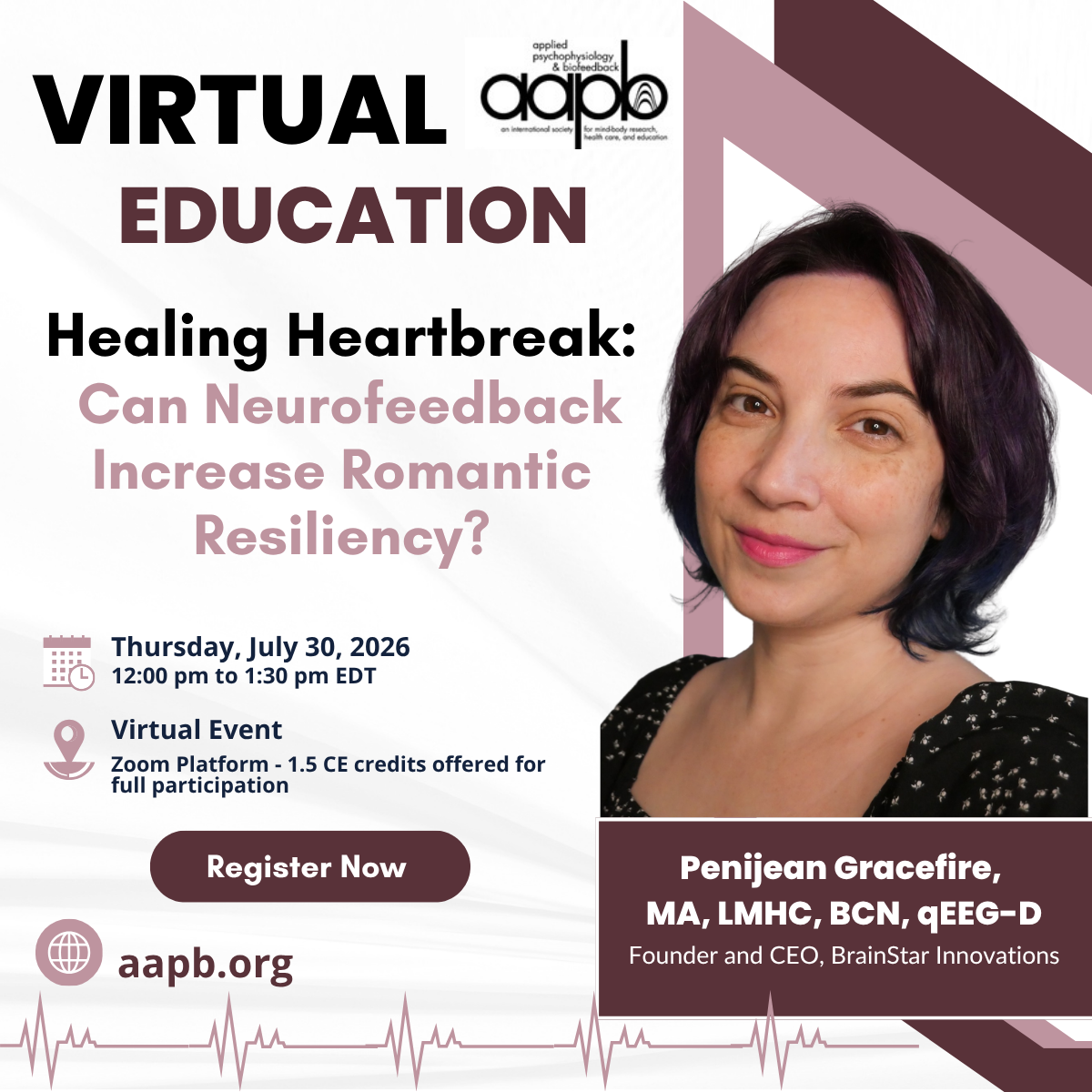
AAPB Virtual Education: Healing Heartbreak: Can Neurofeedback Increase Romantic Resiliency?
Date/Time:
Thursday, July 30, 2026
- 12:00 pm to 1:30 pm EDT
- 11:00 am to 12:30 pm CDT
- 10:00 am to 11:30 am MDT
- 9:00 am to 10:30 am PDT
Originally slated as part of a larger symposium presented at the AAPB 56th Annual Scientific Meeting this past May, Penijean's content was not covered as part of the session due to an overabundance of enthusiastic panelists. Take advantage of this opportunity to spend a full 90-minutes learning from one of AAPB's top presenters.
About this Presentation
In 2016, Penijean Gracefire collaborated with professional rapper Dessa to explore the question: Can neurofeedback help heal a broken heart?
Penijean created an innovative protocol design based on both Dessa's qEEG brain map and an evaluation of the current literature on the neurobiology of romantic love and attachment. Their investigation resulted in an album, a national tour, a TedxWanChai talk, and a collaboration with the Minnesota Orchestra. Penijean went on to develop several neurofeedback techniques inspired by the pre and post findings of this unique case study.
Ten years later, for the first time ever, Penijean will take us behind the curtain to discuss the clinical details of how she approached this unusual project, the specifics behind her protocol design, and reflect on what she has learned in the last decade about the potential of neurofeedback to impact how humans navigate relationships.
CE Credits
1.5 CE credits available for full event participation. You must attend the full, live delivery of the presentation to qualify for CE Credits.
Learning Objectives
As a result of this presentation, you will learn to:
- Identify which regions in the brain, indicated by current published research, are recruited when a person is experiencing heartbreak as a result of a disrupted romantic relationship
- Evaluate the utility of qEEG assessment and sLORETA imaging in determining whether neurofeedback could potentially facilitate a post-relationship recovery arc for a client having difficulty resolving residual romantic feelings
- Select regions to include in an sLORETA z-score neurofeedback training protocol intended to increase romantic resiliency
Target Audience
Anyone interested in how neural networks affect relational dynamics.
Level
Intermediate
Content builds upon the learner's foundational knowledge, familiarity with the literature and/or experience in a content area. Programming at this level includes more depth than at a beginning level program. It could also serve as a refresher course for individuals who have a background in a content area and are interested in learning more contemporary applications.
For those psychologists using the modality of biofeedback and interested in efficacy, science, and latest clinical applications. This conference (1) presents research relevant to psychological practice, education, and science; (2) it is our intention to host an offering to help psychologists to keep up with the most current scientific evidence regarding assessment, intervention, and education; and (3) we believe that this program would allow psychologists to increase competencies in order to improve services to patients. This conference is IN NO WAY a substitute for the basic academic education and training needed for entry into the field of psychology.
Utility and Validity (Risks)
Materials that are included in this course may include interventions and modalities that are beyond the authorized practice of mental health professionals. As a licensed professional, you are responsible for reviewing the scope of practice, including activities that are defined in law as beyond the boundaries of practice in accordance with and in compliance with your profession’s standards.
Potential risks include the typical concerns associated with the possibility of a provider utilizing a general wellness device incorrectly, including increased fatigue, headaches, and muscle tension.
References
Hsu DT, Sankar A, Malik MA, Langenecker SA, Mickey BJ, Love TM. Common neural responses to romantic rejection and acceptance in healthy adults. Soc Neurosci. 2020 Oct;15(5):571-583. doi: 10.1080/17470919.2020.1801502. Epub 2020 Sep 3. PMID: 32715953; PMCID: PMC7674199.
Packheiser J, Berretz G, Rook N, Bahr C, Schockenhoff L, Güntürkün O, Ocklenburg S. Investigating real-life emotions in romantic couples: a mobile EEG study. Sci Rep. 2021 Jan 13;11(1):1142. doi: 10.1038/s41598-020-80590-w. PMID: 33441947; PMCID: PMC7806608.
Wang C, Song S, d'Oleire Uquillas F, Zilverstand A, Song H, Chen H, Zou Z. Altered brain network organization in romantic love as measured with resting-state fMRI and graph theory. Brain Imaging Behav. 2020 Dec;14(6):2771-2784. doi: 10.1007/s11682-019-00226-0. PMID: 31898089.
Yttredahl AA, McRobert E, Sheler B, Mickey BJ, Love TM, Langenecker SA, Zubieta JK, Hsu DT. Abnormal emotional and neural responses to romantic rejection and acceptance in depressed women. J Affect Disord. 2018 Jul;234:231-238. doi: 10.1016/j.jad.2018.02.083. Epub 2018 Feb 27. PMID: 29547816; PMCID: PMC5895529.
Pricing
- AAPB Member and Student Member Price: $55 through July 16; $70 after
- Non-member Price: $85 through July 16; $110 after
- Non-member Student Price: $60 through July 16; $70 after
About Our Presenter
Penijean Gracefire, MA, LMHC, BCN, qEEG-D, Founder and CEO, BrainStar Innovations
Penijean Gracefire is a neural frequency analyst and published author who rides motorcycles, drinks tea, and designs therapeutic applications for emerging neurotechnology. A licensed mental health clinician, she constructs closed loop EEG-based feedback paradigms which alter brain dynamics in real time, helping people to recover from injury and trauma by improving cortical network flexibility and adaptive cascades. Penijean’s ground-breaking work has led to industry-wide changes in neuromodulation and is the basis for current standards in international certification. She is on the front lines of integrating photobiomodulation with mobile EEG technology, advocating for increased affordability and wider access to tools that support brain health. Her passions include spectral analysis, creative delivery mechanisms for caffeine, and taking things apart to see how they work.
Our presenter has no financial interests to disclose.
This presentation will be free of commercial bias.
Delivery Method
Interactive webinar using telephone and Internet technology.
CONTINUING EDUCATION STATEMENTS
 Psychologists: The Association for Applied Psychophysiology and Biofeedback is approved by the American Psychological Association to sponsor continuing education for psychologists. The Association for Applied Psychophysiology and Biofeedback maintains responsibility for the program and its content.
There is no known commercial support for this program. This virtual workshop offers a MAXIMUM of 1.5 CE credits for maximum participation.
BCIA Recertification: Hour-for-hour attendance may be used to fulfill the continuing education requirements for recertification with certificate of attendance.
IMPORTANT NOTICE: Those who attend this event in full and complete the appropriate evaluation form will receive CE credits. Those arriving more than 15 minutes after the start time or leaving before a given activity is completed will not receive CE credit.
Cancellation Policy: Cancellations received by the AAPB office by ten days prior to event will be refunded minus a $25 processing fee. NO REFUNDS WILL BE GRANTED WITHIN TEN DAYS of the event. Cancellations must be made in writing and emailed to [email protected]. Fees cannot be refunded for registrations cancelled after the presentation begins.
Grievance Policy: The Association of Applied Psychophysiology and Biofeedback (AAPB) is fully committed to conducting all activities in strict conformance with the American Psychological Association's Ethical Principles of Psychologists. AAPB will comply with all legal and ethical responsibilities to be non-discriminatory in promotional activities, program content and in the treatment of program participants. The monitoring and assessment of compliance with these standards will be the responsibility of the Education Chair in consultation with the members of the continuing education committee, the AAPB Ethics Chairperson, Continuing Education (CE) Committee Chairperson, Program Planning Committee Chairperson, and/or the Conference Chairperson. While AAPB goes to great lengths to assure fair treatment for all participants and attempts to anticipate problems, there will be occasional issues which come to the attention of the convention staff which require intervention and/or action on the part of the convention staff or an officer of AAPB. This procedural description serves as a guideline for handling such grievances. 1. When a participant, either orally or in written format, files a grievance and expects action on the complaint, the following actions will be taken. If the person toward whom the grievance is directed is also the instructor or a chair of any of the above-mentioned committees, the AAPB Board of Directors will appoint a Board representative to oversee the resolution of any of the participant complaints, in an effort to avoid any and all conflicts of interest. If the grievance concerns a speaker, the content presented by the speaker, or the style of presentation, the individual filing the grievance will be asked to put his/her comments in written format. The CE Chair will then pass on the comments to the speaker, assuring the confidentiality of the grieved individual. 2. If the grievance concerns a workshop offering, its content, level of presentation, or the facilities in which the workshop was offered, the convention chair will mediate and will be the final arbitrator. If the participant requests action, the convention chair will: a) attempt to move the participant to another workshop or b) provide a credit for a subsequent year's workshop or c) provide a partial or full refund of the workshop fee. Actions 2b and 2c will require a written note, documenting the grievance, for record keeping purposes. The note need not be signed by the grieved individual. 3. If the grievance concerns an AAPB CE program, in a specific regard, the CE Chair will attempt to arbitrate.
Contact name(s)*: Leslie Shivers, AAPB Executive Director
Email: [email protected]
Telephone: 800-477-8892 or +1 303-422-8436
Address: PO Box 461797, Aurora, CO 80046-1797
Tickets
$55.00 Member ticket
$70.00 after 12:00 am July 17
$85.00 Non-member ticket
$110.00 after 12:00 am July 17
$60.00 Non-Member Student Ticket
$70.00 after 12:00 am July 17
