
Meeting/Event Information
AAPB Virtual Education: Autonomic Dysfunction and Sensitized Chronic Pain
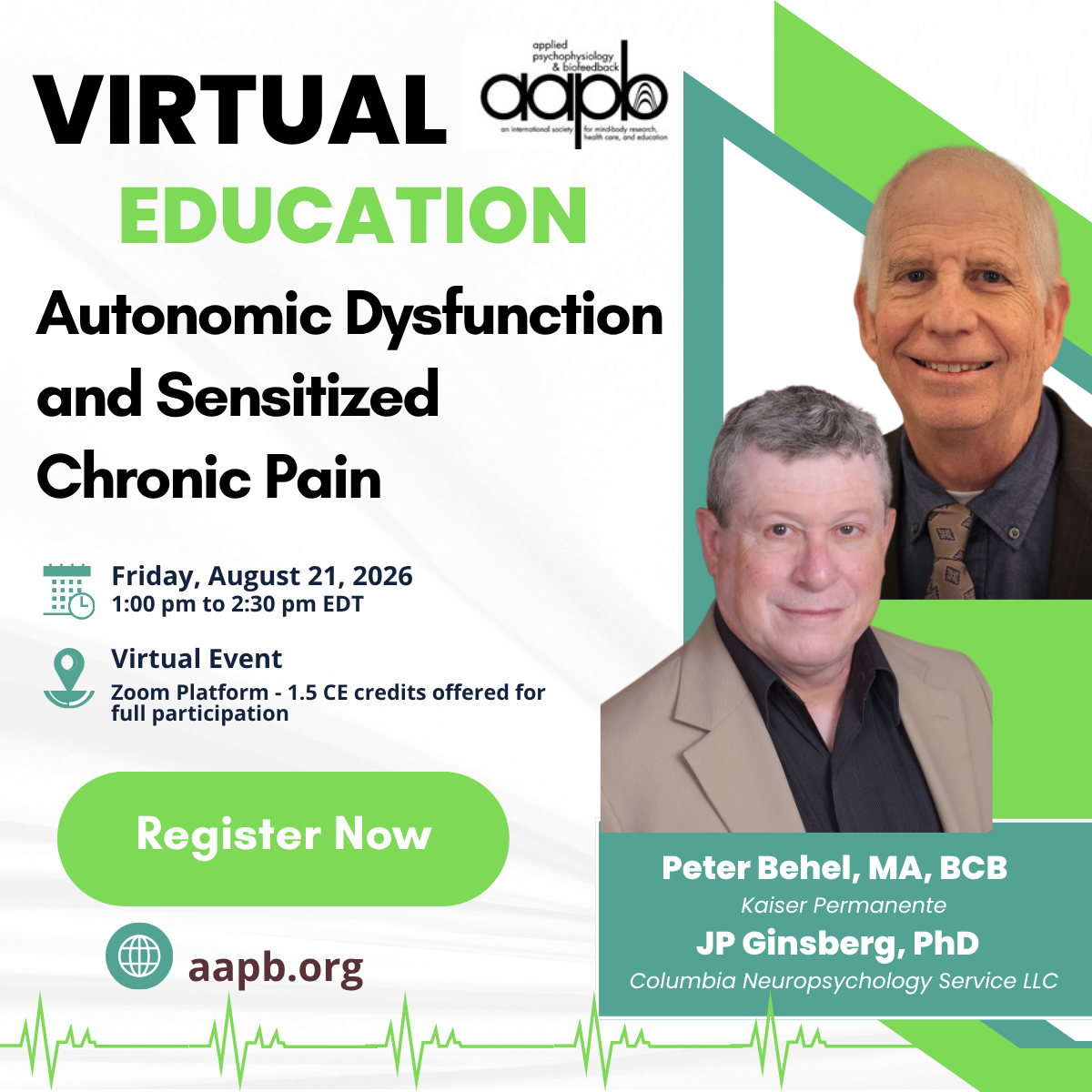
Date:
Friday, August 21, 2026
Time:
- 1:00 pm to 2:30 pm EDT
- 12:00 pm to 1:30 pm CDT
- 11:00 am to 12:30 pm MDT
- 10:00 am to 11:30 am PDT
About this Presentation
This webinar examines the mechanisms underlying the emergence of sensitized chronic pain (SCP) and provides a basis for understanding how SCP is influenced by autonomic dysregulation. The presentation will spotlight the modifications within the peripheral and central nervous systems that lead to increased pain sensitivity, review the interactions between stress and chronic pain, and profile the relationship between heart rate variability (HRV) and sensitized chronic pain.
Research has indicated autonomic dysregulation to be a principal component of the disordered pain signaling that characterizes chronic pain. This has increased recognition of the central role autonomic dysregulation assumes in amplifying pain, leading to hyperalgesia and central sensitization. Heart rate variability biofeedback (HRVB) is an evidence-based training modality utilized to moderate dysregulated autonomic functioning. This webinar will review the application of HRVB pertaining to pain management and central sensitization.
Nociception refers to the transfer of pain signals from the periphery to the spinal cord by dedicated neurons known as nociceptors. Research has determined that the release of norepinephrine enhances nociceptor activation, and this highlights the link between nociceptor sensitization and sympathetic excitation. The involvement of adrenoreceptors equipped with nociceptive coupling additionally provides a basis for autonomic plasticity within pain signal transmission. Maladaptive neuroplasticity is based on sympathetically induced nociceptor hyperexcitability, and the resulting synaptic dysfunction is responsible for nociceptive priming, a persistent hyper functional state that is the hallmark of central sensitization.
Aberrant neuronal excitability has officially become recognized as a stand-alone chronic pain phenotype designated as nociplastic since 2018. Intriguingly, tissue penetration itself is not necessarily required to initiate the nociceptive cascade process classically associated with pain. The recognition of this hyperexcitability phenotype effectively serves to extend the parameters associated with a stress response and increases recognition that moderating persistent sympathetic output assumes a prominent role in the management of SCP.
Pricing
- AAPB Member and Student Member Price: $55 through August 7; $70 after
- Non-member Price: $85 through August 7; $110 after
- Non-member Student Price: $60 through August 7; $70 after
About Our Presenters
Peter Behel, MA, BCB; Kaiser Permanente Contracted Provider
Peter Behel is an autonomic rehabilitation provider who began seeing pain patients in 1987. His work has been profiled in the 1997 No. 1 New York Times bestseller, 8 Weeks to Optimum Health. Peter is a former President of the Biofeedback Society of California and has been a biofeedback provider for pain management at St. Helena Hospital and for Kaiser Permanente. Peter formerly instructed a course at Sonoma State University entitled Biofeedback, Stress Management and Somatic Psychology from 2015 through 2023. In 2023 Peter became Chair of the Biofeedback in Autonomic Rehabilitation task force for the American Congress of Rehabilitation Medicine. He is the author of multiple peer-reviewed articles on applied autonomic regulation, and he continues to give presentations on chronic pain and autonomic dysregulation.
JP Ginsberg, PhD; Licensed Clinical Psychologist/Columbia Neuropsychology Service LLC
Dr. Ginsberg is a Licensed Clinical Psychologist/Neuropsychologist in Columbia, SC. He retired from practice at the VA hospital in 2019 and is a Research Associate Professor at School of Medicine, University of South Carolina and Adjunct Faculty at Saybrook University. Dr. Ginsberg has been a PI, Co-PI or Co-I on research grants from the DoD, VA, and NIH studying heart rate variability (HRV) and HRV biofeedback in patients with either chronic pain or PTSD. Currently he is collaborating or consulting with researchers at several universities. Dr. Ginsberg has advocated for self-empowered integrative management of chronic pain and PTSD using autonomic self-regulation as a mind-body treatment for over 20 years. He authored or co-authored more than 75 peer reviewed scientific publications, chapters, and abstracts; served as a scientist reviewer of research grant proposals and edited or reviewed numerous published scientific articles; and given invited presentations on HRV and HRVB at scientific meetings, academic seminars, and webinars.
Disclosure: Our presenters have no financial interests to disclose.
This presentation will be free of commercial bias.
CE Credits
1.5 CE credits available for full event participation. You must attend the full, live delivery of the presentation to qualify for CE Credits.
Learning Objectives
As a result of this presentation, you will learn to:
- Summarize the basic nociceptor-autonomic interactions that facilitate the pain reflex
- Describe the maladaptive neuroplastic changes that are associated with sensitized pain
- Describe how the chronic stress response cycle supports pain sensitization
- Describe the measures used to monitor and track changes in HRV after HRVB
Target Audience
Pain practitioners; anyone with interest in HRVB for pain management
Focus
50% Clinicial/50% Research
Level
Intermediate
Content builds upon the learner's foundational knowledge, familiarity with the literature and/or experience in a content area. Programming at this level includes more depth than at a beginning level program. It could also serve as a refresher course for individuals who have a background in a content area and are interested in learning more contemporary applications.
For those psychologists using the modality of biofeedback and interested in efficacy, science, and latest clinical applications. This conference (1) presents research relevant to psychological practice, education, and science; (2) it is our intention to host an offering to help psychologists to keep up with the most current scientific evidence regarding assessment, intervention, and education; and (3) we believe that this program would allow psychologists to increase competencies in order to improve services to patients. This conference is IN NO WAY a substitute for the basic academic education and training needed for entry into the field of psychology.
Utility and Validity (Risks)
Materials that are included in this course may include interventions and modalities that are beyond the authorized practice of mental health professionals. As a licensed professional, you are responsible for reviewing the scope of practice, including activities that are defined in law as beyond the boundaries of practice in accordance with and in compliance with your profession’s standards.
No risks have been identified.
References
Behel, P. (2024). Neuron Bombardment and Cycling Neurotransmission: The Downstream Impact of Persistent Sympathetic Activation. American Journal of Biomedical Science & Research. 24(1) AJBSR.MS.ID.003165, DOI:10.34297/AJBSR.2024.24.003165
Behel, P. (2022). Central Sensitization: The Unrecognized Expression of Autonomic Dysregulation. International Journal of Arts, Humanities & Social Science. 03. 44-47.10.56734/ijahss.v3n9a6.
Behel P. (2015). Modulating pain signal transmission: How targeted nervous system regulation can manage pain without side effects. The Pain Practitioner; 25(4): 44-47
Burch, JB, Weggen, J, Ginsberg, B, Maxwell, M, Nath, S, Varner, M, Boylan, L, Chelimsky, T, Chelimsky, G, Kinser, P, McLeod, BD, Ginsberg, JP, Gharbo, R. (2025, 05/16) Heart Rate Variability Skills Training for Autonomic Rehabilitation (HRV STAR): Examining Clinical Implementation Feasibility. Poster presentation, 55th Annual AAPB Scientific Conference, San Diego, CA.
Gharbo, R., Bagherpour, R., Lazarus, N., Mehrdady, R., Ginsberg, J. P. (2019). Untangling chronic pain and hyperarousal with heart rate variability: A case report. Practical Pain Management 19(7), 33-36.
Continuing Education Statement

Psychologists: The Association for Applied Psychophysiology and Biofeedback is approved by the American Psychological Association to sponsor continuing education for psychologists. The Association for Applied Psychophysiology and Biofeedback maintains responsibility for the program and its content.
This virtual workshop offers a MAXIMUM of 1.5 CE credits for maximum participation.
BCIA Recertification: Hour-for-hour attendance may be used to fulfill the continuing education requirements for recertification with certificate of attendance.
Coverage & Reciprocity
Psychologists (APA) Coverage & Reciprocity
The following state boards accept courses from APA providers for Counselors: AK, AL, AR, AZ, CA, CO, CT, DC, DE, FL, GA, HI, IA, ID, IL, IN, KS, KY, MD, ME, MO, NC, ND, NH, NE, NJ, NM, NV, OK*, OR, PA, RI, SC, SD, TN, TX, UT, VA, WI, WY
MI: No CE requirements
The following state boards accept courses from APA providers for MFTs: AK, AR, AZ, CA, CO, CT, DE, FL, GA, IA, ID, IN, KS, MD, ME, MO, NE, NC, NH, NJ, NM, NV, OK*, OR, PA, RI, SC, SD, TN, TX, UT, VA, WA, WI, WY
The following state boards accept courses from APA providers for Addictions Professionals: AK, AR, CO, CT, DC, DE, GA, IA, IN, KS, LA, MD, MO, MT, NC, ND, NE, NJ, NM, NY (outstate held), OK*, OR, SC, UT, WA, WI, WY
* OK accepts APA credit for live, in-person activities. For all ethics and/or online courses, an application is required.
MA / MFTs: Participants can self-submit courses not approved by the MAMFT board for review.
The following state boards accept courses from APA providers for Social Workers: AK, AR, AZ, CA, CO, DE, FL, GA, ID, IN, KY, ME, MN, MO, NE, NH, NM, OR, PA, VT, WI, WY
IMPORTANT NOTICE: Those who attend this event in full and complete the appropriate evaluation form will receive CE credits. Those arriving more than 15 minutes after the start time or leaving before a given activity is completed will not receive CE credit.
Cancellation Policy: Cancellations received by the AAPB office by ten days prior to event will be refunded minus a $25 processing fee. NO REFUNDS WILL BE GRANTED WITHIN TEN DAYS of the event. Cancellations must be made in writing and emailed to [email protected]. Fees cannot be refunded for registrations cancelled after the presentation begins.
Grievance Policy: The Association of Applied Psychophysiology and Biofeedback (AAPB) is fully committed to conducting all activities in strict conformance with the American Psychological Association's Ethical Principles of Psychologists. AAPB will comply with all legal and ethical responsibilities to be non-discriminatory in promotional activities, program content and in the treatment of program participants. The monitoring and assessment of compliance with these standards will be the responsibility of the Education Chair in consultation with the members of the continuing education committee, the AAPB Ethics Chairperson, Continuing Education (CE) Committee Chairperson, Program Planning Committee Chairperson, and/or the Conference Chairperson. While AAPB goes to great lengths to assure fair treatment for all participants and attempts to anticipate problems, there will be occasional issues which come to the attention of the convention staff which require intervention and/or action on the part of the convention staff or an officer of AAPB. This procedural description serves as a guideline for handling such grievances. 1. When a participant, either orally or in written format, files a grievance and expects action on the complaint, the following actions will be taken. If the person toward whom the grievance is directed is also the instructor or a chair of any of the above-mentioned committees, the AAPB Board of Directors will appoint a Board representative to oversee the resolution of any of the participant complaints, in an effort to avoid any and all conflicts of interest. If the grievance concerns a speaker, the content presented by the speaker, or the style of presentation, the individual filing the grievance will be asked to put his/her comments in written format. The CE Chair will then pass on the comments to the speaker, assuring the confidentiality of the grieved individual. 2. If the grievance concerns a workshop offering, its content, level of presentation, or the facilities in which the workshop was offered, the convention chair will mediate and will be the final arbitrator. If the participant requests action, the convention chair will: a) attempt to move the participant to another workshop or b) provide a credit for a subsequent year's workshop or c) provide a partial or full refund of the workshop fee. Actions 2b and 2c will require a written note, documenting the grievance, for record keeping purposes. The note need not be signed by the grieved individual. 3. If the grievance concerns an AAPB CE program, in a specific regard, the CE Chair will attempt to arbitrate.
Contact name(s)*: Leslie Shivers, AAPB Executive Director
Email: [email protected]
Telephone: 800-477-8892 or +1 303-422-8436
Address: PO Box 461797, Aurora, CO 80046-1797
Tickets
$55.00 Member ticket
$70.00 after 12:00 am August 8
$85.00 Non-member ticket
$110.00 after 12:00 am August 8
$60.00 Non-Member Student Ticket
$70.00 after 12:00 am August 8
