
Meeting/Event Information
AAPB Virtual Education: Beyond Symptoms: A Systems-Biology Approach to Brain Health
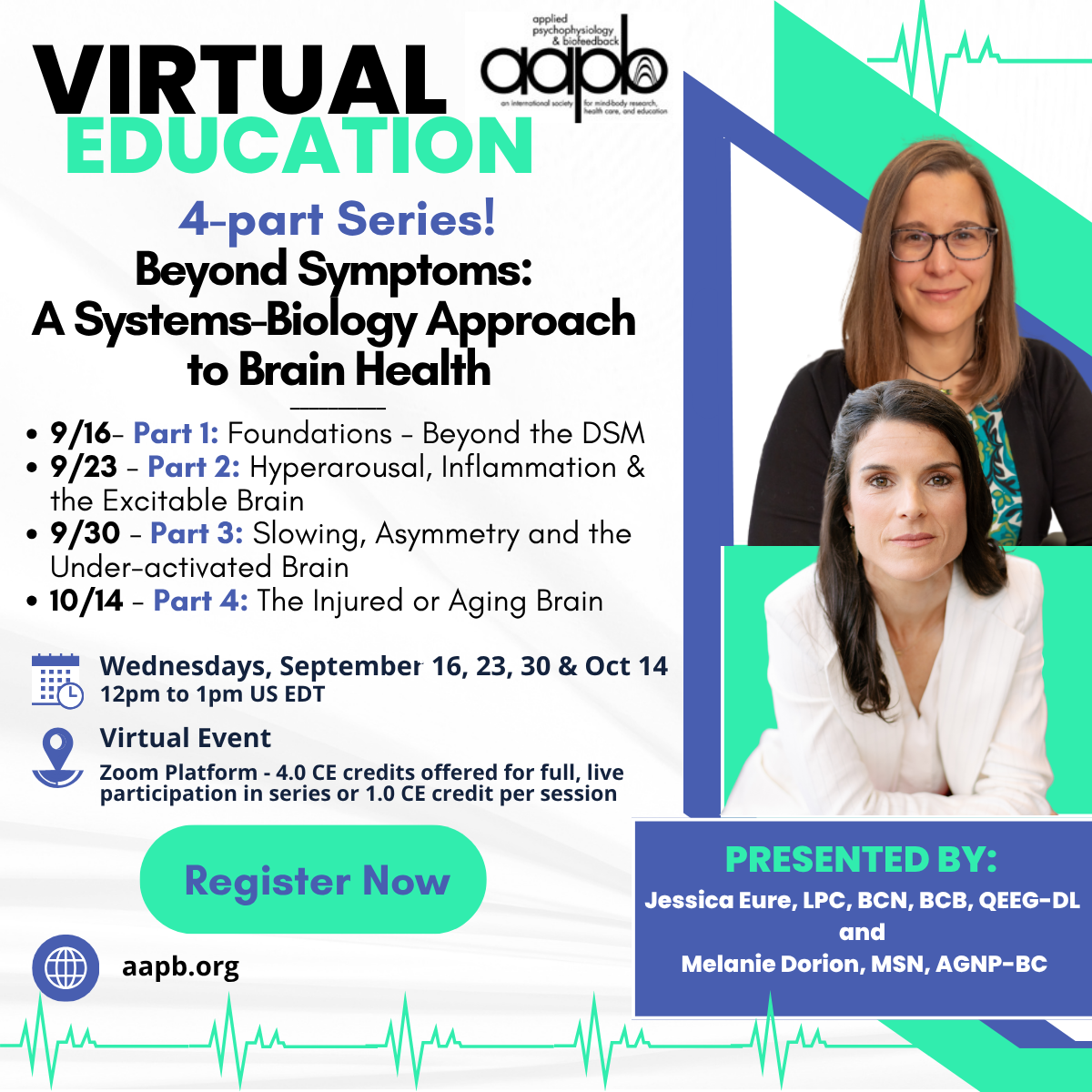
JOIN US FOR THE FULL SERIES or BY SESSION!
Wednesday, September 16, 2026 - Part 1: Foundations - Beyond the DSM
This session gives clinicians a concrete framework for moving from symptom-label thinking to root-cause thinking, which improves clinical recommendations and precision care for clients.
Wednesday, September 23, 2026 - Part 2: Hyperarousal, Inflammation & the Excitable Brain
This session teaches clinicians to recognize hyperarousal phenotypes and to pursue the appropriate assessments and referrals, reducing trial-and-error treatment and improving outcomes in otherwise refractory clients.
Wednesday, September 30, 2026 - Part 3: Slowing, Asymmetry and the Under-activated Brain
This session equips clinicians to recognize underactivation and asymmetry phenotypes and to pursue or refer for the relevant endocrine, metabolic, and circadian evaluation, improving outcomes for clients who respond poorly to symptom-only treatment.
Wednesday, October 14, 2026- Part 4: The Injured or Aging Brain
This session teaches clinicians to recognize structural and aging-brain phenotypes, pursue the relevant assessments, and integrate multimodal, evidence-informed interventions and referrals.
All sessions will occur at the same time:
- 12:00 pm to 1:00 pm US EDT
- 11:00 am to 12:00 pm US CDT
- 10:00 am to 11:00 am US MDT
- 9:00 am to 10:00 am US PDT
About this Series
Part 1: Foundations - Beyond the DSM
This opening session of a four-part advanced series establishes the conceptual foundation for phenotype-guided, whole-person clinical care. DSM categories describe clusters of symptoms but say little about the underlying brain physiology that produces them, and they predict treatment response poorly. Drawing on the QEEG phenotype literature, this session presents a complementary framework: identifiable, brain-based phenotypes that cut across diagnostic boundaries and point more directly toward effective intervention. Jessica Eure will introduce QEEG phenotype thinking, the limits of symptom-based diagnosis, and evidence that brain-based patterns can help predict medication and neurofeedback response. Melanie Dorion will introduce a systems-biology / functional-medicine model organized around upstream pillars including diet and lifestyle, environmental exposures (toxins and infections), hormones (thyroid, metabolic, sex, and HPA-axis), and nutrients and show how each can drive or modulate the phenotypes clinicians observe. Together they frame the central thesis of the series: QEEG phenotypes are the brain’s measurable responses to upstream, testable, and often modifiable drivers. Participants will learn to conceptualize a presenting case by mechanism rather than label, setting up the three mechanism-focused sessions that follow (hyperarousal/inflammation; slowing/asymmetry; structural/aging). The session emphasizes that this integrative, evidence-informed lens is intended to complement, rather than replace, standard diagnostic and medical care, and that recommended assessments and interventions must remain within each clinician’s scope of practice. By the close, attendees will be able to articulate why two clients with the same DSM diagnosis may require entirely different interventions, and how a systems-biology framework guides that differentiation.
Learning Objectives:
- Describe the limitations of DSM-based diagnostic categories in predicting treatment response, and explain how QEEG phenotypes provide a complementary brain-based framework for clinical conceptualization
- Identify the main functional-medicine pillars (diet/lifestyle, environmental exposures, hormones, and nutrients) and explain how they can serve as an upstream contributor to the QEEG phenotypes seen in clinical practice
- Summarize the evidence base supporting phenotype-guided treatment selection, including medication response prediction and personalized intervention planning
- Apply a systems-biology framework to a clinical case by integrating presenting symptoms, QEEG findings, and potential physiological contributors into an initial conceptualization
Part 2: Hyperarousal, Inflammation & the Excitable Brain
The second session examines the most common QEEG phenotypes that indicate cortical hyperexcitability: global excess beta, spindling excessive beta, and paroxysmal activity, and the physiological drivers that are correlated with them. These patterns appear across many DSM diagnoses (anxiety, PTSD, Autism, mood and behavioral presentations) and are frequently missed in routine psychiatric care. Jessica Eure will present the QEEG phenotype evidence, including recent work linking spindling excessive beta to neuroinflammation and data showing that recognizing subclinical epileptiform activity can change treatment course. Melanie Dorion will connect these phenotypes to their upstream drivers through the functional medicine lens: infection and post-infectious states (including Lyme and post-viral / COVID-19 syndromes), environmental toxic load, gut-derived inflammation, HPA-axis dysregulation, and nutrient status (magnesium, B vitamins, omega-3 fatty acids). Management and testing options including peptides, supplements and medications will be discussed. The integrative clinical story is that hyperarousal phenotypes often represent the brain’s response to inflammation, infection, or toxic burden; symptomatic suppression (for example, with anticonvulsants) addresses the downstream pattern, while identifying and treating the driver targets the cause. Participants will leave able to recognize hyperexcitability phenotypes, articulate their inflammatory, infectious, and toxic contributors. The session emphasizes clinical evidence and appropriate referrals.
Learning Objectives:
- Identify the QEEG phenotypes associated with cortical hyperexcitability including excess beta, beta spindles, and paroxysmal activity and describe their typical clinical presentations across diagnostic categories
- Explain the relationship between neuroinflammation, infection (including Lyme, post-viral syndromes, and COVID-19), environmental toxins, and the development of hyperarousal QEEG phenotypes
- List the laboratory tests, biomarkers, and functional-medicine assessments most relevant to investigating immune, infectious, and inflammatory contributors in clients presenting with hyperarousal phenotypes (e.g., inflammatory markers, infection panels, gut-permeability testing, environmental toxin screening).
- Discuss how nutritional deficiencies (e.g., magnesium, B vitamins, omega-3 fatty acids) and dietary factors may contribute to or modulate cortical excitability and identify corresponding clinical interventions
Part 3: Slowing, Asymmetry and the Under-activated Brain
The third session addresses the phenotypes associated with cortical underactivation and asymmetry including frontal alpha asymmetry, diffuse slowing and localized excess theta or alpha patterns commonly seen in depression, low motivation, anxiety, ADHD and trauma-related presentations. Jessica Eure will present the asymmetry and slowing literature. Melanie Dorion will demonstrate how the same phenotypes are frequently downstream of modifiable physiology: thyroid dysfunction (including subclinical hypothyroidism that mimics depression), HPA-axis dysregulation, sex-hormone changes (perimenopause, low testosterone), insulin resistance, nutrient deficiencies (B12, methylation, vitamin D, iron/ferritin, omega-3s, amino-acid precursors), and circadian/light disruption. A brief introduction and overview of the management and testing options including peptides, supplements and medications will be discussed. The unifying clinical message is that frontal alpha asymmetry and slowing are not synonymous with depression; they may be the brain’s response to some of these functional drivers. Just as antidepressants can normalize the EEG, so too may upstream interventions such as thyroid optimization, methylation support, or circadian regulation. Participants will learn to recognize the phenotypes, articulate the endocrine and metabolic contributors that can mimic primary mood disorders, identify the relevant biomarkers, and incorporate sleep, circadian, and light-exposure considerations into clinical recommendations.
Learning Objectives
- Recognize the QEEG phenotypes associated with mood, motivation, and trauma-related presentations—including frontal alpha asymmetry, diffuse slowing, and excess theta/alpha presentations and describe their associations with depression, anxiety, and PTSD
- Explain how endocrine and metabolic factors (thyroid function, HPA-axis dysregulation, sex hormones, and insulin signaling) can produce or exacerbate phenotypes that mimic primary mood disorders
- Identify key nutritional biomarkers (e.g., vitamin D, B12, folate, ferritin, omega-3 index) relevant to evaluating clients with QEEG phenotypes
- Describe the role of sleep, circadian rhythm, and light exposure and to how they impact the vigilance stability of the EEG and how that presents in the brainwave data
Part 4: The Injured or Aging Brain
The closing session turns to the injured or aging brain: traumatic brain injury, cerebrovascular compromise, mild cognitive impairment, and dementia. Jessica Eure will present the QEEG phenotypes associated with injury, vascular change, and cognitive decline, including how quantitative EEG can help differentiate normal age-related change from pathological decline and how it can track recovery. A key conceptual thread links this session back to Session 2: emerging evidence reframing aspects of Alzheimer’s disease as partly an excitability and inflammatory process, reinforcing the series’ systems-biology argument that dementia is not a single entity. Melanie Dorion will present the modifiable drivers of decline and impaired recovery through the functional medicine lens: metabolic health (insulin resistance, cardiovascular/vascular function, ApoE genotype and dietary fat), hormonal change (thyroid and cognition, estrogen neuroprotection, cortisol and hippocampal vulnerability), nutrient status (B-vitamins and homocysteine, omega-3s, vitamin D, antioxidants), environmental burden (heavy metals, air pollution, mold, prior infection including COVID-19 and Lyme), and sleep / glymphatic clearance. The integrative message is that post-injury and cognitive decline are not fixed endpoints; vascular, metabolic, and inflammatory contributors are modifiable, and multimodal strategies—neurofeedback, hyperbaric oxygen therapy, nutritional and hormonal support, sleep optimization, and lifestyle change—may support function and recovery. Participants will learn to recognize the relevant phenotypes, characterize the metabolic, vascular, hormonal, and inflammatory drivers, identify appropriate assessments, and integrate evidence-informed interventions into a multimodal plan. The session closes the series on a forward-looking, intervention-oriented note while underscoring that these approaches complement standard neurological and medical care.
Learning Objectives
- Identify the QEEG phenotypes associated with traumatic brain injury, cerebrovascular compromise, mild cognitive impairment, and dementia, and differentiate age-related cognitive changes from pathological decline
- Explain the contributions of metabolic health (insulin resistance, cardiovascular function, ApoE genotype), hormonal changes, and chronic inflammation to cognitive decline and impaired post-injury recovery
- List the laboratory and functional medicine assessments most useful in evaluating modifiable contributors to cognitive decline and brain-injury recovery (e.g., homocysteine, hs-CRP, lipid panel, hormone panels, heavy-metal testing, infection history)
- Describe evidence-informed interventions including neurofeedback, hyperbaric oxygen therapy, nutritional support, sleep optimization, and lifestyle modification that may support cognitive function and recovery and integrate these into a multimodal treatment plan
Attendees will earn 1.0 CE credits for full participation per session or 4.0 CE credits for full series.
Pricing
AAPB Member and Student Member Price:
Full Series: $150 through September 2; $200 after
Per Session: $55 through September 2; $70 after
Non-member Price:
Full Series: $200 through September 2; $275 after
Per Session: $85 through September 2; $110 after
Non-member Student Price:
Full Series: $155 through September 2; $200 after
Per Session: $60 through September 2; $70 after
About Our Presenters
Jessica Eure, LPC, BCN, BCB, QEEG-DL - Mental Health Counselor, Virginia Center for Neurofeedback, Attachment & Trauma
Jessica is a licensed counselor and co-founder of the Virginia Center for Neurofeedback, Attachment & Trauma in Charlottesville, Virginia, where she has practiced since 2009. She is board-certified in neurofeedback, biofeedback and QEEG. Alongside her practice, Jessica has spent more than a decade serving the professional neurofeedback community — including two terms as president of the Mid-Atlantic Biofeedback Society, Treasurer and Program Committee Chair for AAPB, and Secretary of the International QEEG Certification Board. She also enjoys mentoring other professionals in neurofeedback and QEEG.
Our presenter has no financial interests to disclose.
Melanie Dorion, MSN, APRN, AGNP-BC - Integrative and Functional Medicine Nurse Practitioner
Melanie Dorion, MSN, APRN, is an Integrative and Functional Medicine Nurse Practitioner with over 12 years of experience supporting adults and older adults in the prevention, reversal, and management of chronic and complex conditions. Her work integrates functional medicine, lifestyle optimization, and advanced therapies—including peptides, IV nutrient therapy, and personalized nutrition—to restore vitality and support long-term health sovereignty. Her background bridges nursing, naturopathic, and clinical research perspectives. She studied Naturopathic Medicine at Bastyr University and earned her Nurse Practitioner degree from Seattle University, with advanced training in geriatrics, obesity medicine, nutrition, exercise science, herbal medicine, and genetics. Her clinical work is informed by both professional expertise and lived experience in reversing chronic fatigue. A former professional cyclist for the Canadian National Team, she brings a unique understanding of performance, recovery, and resilience. In addition to chronic illness care, she has worked with athletes, executives, and high performers to optimize focus, energy, and cognitive resilience through evidence-based performance and precision medicine. She has contributed extensively to professional education, including teaching with Pentad Integrative Health, co-hosting the To Your Health radio show, and presenting for organizations such as Genova Diagnostics, A4M, Biohealth Congress FIM, and Mary Baldwin University. Her current work centers on advancing innovative, collaborative models of integrative, preventive, and performance-focused care.
Our presenter has no financial interests to disclose.
This series will be presented free of commercial bias.
CE Credits
4.0 CE credits available for full series participation and 1.0 CE credit awarded per session. You must attend the full, live virtual delivery of the presentation(s) to qualify for CE Credits.
Target Audience
Licensed mental health and healthcare providers seeking advanced continuing education—psychologists, professional counselors, clinical social workers, marriage and family therapists, psychiatric and primary-care nurse practitioners, physicians, and BCIA/IQCB board-certified or board-seeking neurofeedback and QEEG practitioners. Attendees should have foundational familiarity with EEG/QEEG concepts; the series is pitched at an advanced level for clinicians integrating brain-based assessment with whole-person care.
Level
ADVANCED
Builds upon established experience, knowledge, and skills in the content area. This may include more diverse applications to specific populations or a novel application of the skill presented. Advanced level programming tends to be more specialized in nature and allows the learner to integrate and enhance knowledge and skills into their practice or other professional domains.
For those psychologists using the modality of biofeedback and interested in efficacy, science, and latest clinical applications, this conference (1) presents research relevant to psychological practice, education, and science; (2) it is our intention to host a continuing education offering to help psychologists to keep up with the most current scientific evidence regarding assessment, intervention, and education; and (3) we believe that this program would allow psychologists, or other healthcare and mental healthcare practitioners, to increase competencies in order to improve services to patients/clients. This conference is IN NO WAY a substitute for the basic academic, accredited education and training needed for entry into the field of psychology.
Utility and Validity (Risks)
Materials that are included in this course may include interventions and modalities that are beyond the authorized practice of mental health professionals. As a licensed professional, you are responsible for reviewing the scope of practice, including activities that are defined in law as beyond the boundaries of practice in accordance with and in compliance with your profession’s standards.
QEEG phenotyping is an assessment aid, not a stand-alone diagnostic test; findings must be interpreted by qualified personnel alongside clinical and medical evaluation. Phenotype-guided treatment selection is supported by a developing evidence base and is not a substitute for standard medical diagnosis or care. Recommendations regarding laboratory testing, nutrients, hormones, or lifestyle interventions fall within the medical scope of practice and must be made only by appropriately licensed providers; mental health clinicians should refer accordingly. Evidence presented derives from peer-reviewed QEEG, neurofeedback, and functional/precision-medicine literature; levels of evidence vary by topic and will be characterized for attendees.
This educational series does not certify attendees to read EEG/QEEG or to diagnose or treat seizure disorders, infections, or inflammatory conditions. Epileptiform or paroxysmal findings require evaluation and management by qualified medical providers (e.g., neurology); QEEG is an aid to, not a replacement for, clinical EEG and medical assessment. Decisions about anticonvulsant or other medications are physician decisions.
Recommendations regarding infection work-up, toxin screening, and nutrient or dietary intervention fall within the medical scope of practice and require appropriate licensure or referral. Evidence presented derives from peer-reviewed QEEG, neurofeedback, neuroinflammation, and functional-medicine literature; levels of evidence vary by topic and will be characterized for attendees.
References
Perl, M., & Perl, D. (2019). EEG amplitude neurofeedback: A review of the research. Asia Pacific Journal of Neurotherapy, 1(1), 44–55.
Swatzyna, R. J., Arns, M., Tarnow, J. D., Turner, R. P., Barr, E., MacInerney, E. K., Hofman, A. M., & Boutros, N. N. (2022). Isolated epileptiform activity in children and adolescents: Prevalence, relevance, and implications for treatment. European Child & Adolescent Psychiatry, 31(4), 545–552. https://doi.org/10.1007/s00787-020-01597-2
Swatzyna, R. J., Morrow, L. M., Collins, D. M., Barr, E. A., Roark, A. J., & Turner, R. P. (2024). Evidentiary significance of routine EEG in refractory cases: A paradigm shift in psychiatry. Clinical EEG and Neuroscience, 55(3), 372–382. https://doi.org/10.1177/15500594231221313
Swatzyna, R. J., Tarnow, J. D., Turner, R. P., Roark, A. J., MacInerney, E. K., & Kozlowski, G. P. (2017). Integration of EEG into psychiatric practice: A step toward precision medicine for autism spectrum disorder. Journal of Clinical Neurophysiology, 34(3), 230–235. https://doi.org/10.1097/WNP.0000000000000365
Nikolova, V. L., Hall, M. R. B., Hall, L. J., Cleare, A. J., Stone, J. M., & Young, A. H. (2021). Gut microbiota in psychiatric disorders: A systematic review. Clinical Psychology Review, 83, 101943. https://pubmed.ncbi.nlm.nih.gov/34117156/
Kabthymer, R. H., Karimi, L., Livesay, K., Lee, M., Apostolopoulos, V., Millar, R., McKay, S., Barry, S., Niño, O. C., Fitó Colomer, M., Soultanakis, H., Conduit, R., Takac, M., Mizzi, S., Sidossis, L. S., Tierney, A., Itsiopoulos, C., & de Courten, B. (2025). Effect of Mediterranean diet on mental health outcomes: A systematic review. Nutrition Research Reviews. https://doi.org/10.1017/S0954422425100243
O'Neil, A., Berk, M., Jacka, F. N., Opie, R. S., Itsiopoulos, C., Cotton, S. M., Castle, D., Mihalopoulos, C., & colleagues. (2024). Clinical and cost-effectiveness of remote-delivered, online lifestyle therapy versus psychotherapy for reducing depression: Results from the CALM non-inferiority, randomised trial. The Lancet Regional Health – Western Pacific, 50, 101142. https://doi.org/10.1016/j.lanwpc.2024.101142
Fesharaki-Zadeh, A., Lowe, N., & Arnsten, A. F. T. (2023). Clinical experience with the α2A-adrenoceptor agonist, guanfacine, and N-acetylcysteine for the treatment of cognitive deficits in "Long-COVID19." Neuroimmunology Reports, 3, 100154. https://doi.org/10.1016/j.nerep.2022.100154
Krepel, N., van Dijk, H., Sack, A. T., Swatzyna, R. J., & Arns, M. (2021). To spindle or not to spindle: A replication study into spindling excessive beta as a transdiagnostic EEG feature associated with impulse control. Biological Psychology, 165, 108188. https://doi.org/10.1016/j.biopsycho.2021.108188
Morrow, L. M., Barr, E. A., Grossi, E., Pillai, V. K., Kight, K. A., Wright, E. B., Turner, R. P., & Swatzyna, R. J. (2025). Identifying neuroinflammation: The diagnostic potential of spindling excessive beta in the EEG. Clinical EEG and Neuroscience. Advance online publication. https://doi.org/10.1177/15500594251376475
Popescu, M., Popescu, E.-A., DeGraba, T. J., & Hughes, J. D. (2020). Altered modulation of beta band oscillations during memory encoding is predictive of lower subsequent recognition performance in post-traumatic stress disorder. NeuroImage: Clinical, 25, 102154. https://doi.org/10.1016/j.nicl.2019.102154
Bransfield, R. C. (2018). Neuropsychiatric Lyme borreliosis: An overview with a focus on a specialty psychiatrist's clinical practice. Healthcare, 6(3), 104. https://doi.org/10.3390/healthcare6030104
Shelton, J. F., Geraghty, E. M., Tancredi, D. J., Delwiche, L. D., Schmidt, R. J., Ritz, B., Hansen, R. L., & Hertz-Picciotto, I. (2014). Neurodevelopmental disorders and prenatal residential proximity to agricultural pesticides: The CHARGE study. Environmental Health Perspectives, 122(10), 1103–1109. https://doi.org/10.1289/ehp.1307044
A state-of-the-science review of the effect of damp- and mold-affected housing on mental health. (2024). Environmental Health Perspectives. https://ehp.niehs.nih.gov/doi/10.1289/EHP14341
Salama, A., Abdel-Latif, S., Omar, T., & Abou El Wafa, H. (2022). Neurofeedback training and cognitive behavior therapy for treatment of generalized anxiety disorder in children and adolescents: A comparative study. NeuroRegulation, 9(1), 29–38. https://doi.org/10.15540/nr.9.1.29
White, E. K., Groeneveld, K. M., Tittle, R. K., Bolhuis, N. A., Martin, R. E., Royer, T. G., & Fotuhi, M. (2017). Combined neurofeedback and heart rate variability training for individuals with symptoms of anxiety and depression: A retrospective study. NeuroRegulation, 4(1), 37–55. https://doi.org/10.15540/nr.4.1.37
van der Vinne, N., Vollebregt, M. A., Boutros, N. N., Fallahpour, K., van Putten, M. J. A. M., & Arns, M. (2019). Normalization of EEG in depression after antidepressant treatment with sertraline? A preliminary report. Journal of Affective Disorders, 259, 67–72. https://doi.org/10.1016/j.jad.2019.08.016
Tang, R., Wang, J., Yang, L., Ding, X., Zhong, Y., Pan, J., Yang, H., Mu, L., Chen, X., & Chen, Z. (2019). Subclinical hypothyroidism and depression: A systematic review and meta-analysis. Frontiers in Endocrinology, 10, 340. https://doi.org/10.3389/fendo.2019.00340
Pariante, C. M., & Lightman, S. L. (2008). The HPA axis in major depression: Classical theories and new developments. Trends in Neurosciences, 31(9), 464–468. https://doi.org/10.1016/j.tins.2008.06.006
Kan, C., Silva, N., Golden, S. H., Rajala, U., Timonen, M., Stahl, D., & Ismail, K. (2013). A systematic review and meta-analysis of the association between depression and insulin resistance. Diabetes Care, 36(2), 480–489. https://doi.org/10.2337/dc12-1442
Peterson, T., AbouAssaly, J., Bessler, W., Burgin, S., Sherwin, R., & Strale, F., Jr. (2024). Longitudinal outcomes of neurofeedback and hyperbaric oxygen therapy in treating a traumatic brain injury patient: A case report. Cureus, 16(7), e64918. https://doi.org/10.7759/cureus.64918
Vossel, K. A., Tartaglia, M. C., Nygaard, H. B., Zeman, A. Z., & Miller, B. L. (2017). Epileptic activity in Alzheimer's disease: Causes and clinical relevance. The Lancet Neurology, 16(4), 311–322. https://doi.org/10.1016/S1474-4422(17)30044-3
Kober, S. E., Schweiger, D., Reichert, J. L., Neuper, C., & Wood, G. (2017). Upper alpha based neurofeedback training in chronic stroke: Brain plasticity processes and cognitive effects. Applied Psychophysiology and Biofeedback, 42(1), 69–83. https://doi.org/10.1007/s10484-017-9353-5
Fang, M., Hu, J., Weiss, J. et al. Lifetime risk and projected burden of dementia. Nat Med 31, 772–776 (2025). https://doi.org/10.1038/s41591-024-03340-9
Liu, P., Wu, L., Peng, G., et al. (2022). Gut microbiota in patients with Alzheimer's disease spectrum: A systematic review and meta-analysis. Ageing Research Reviews, 77, 101614. https://doi.org/10.1016/j.arr.2022.101614
Bisht, K., Sharma, K. P., & Tremblay, M.-È. (2021). Environmental toxins and Alzheimer's disease. Acta Neurologica Scandinavica. Advance online publication. https://doi.org/10.1080/07853890.2021.1966088
Continuing Education Statements
Psychologists: The Association for Applied Psychophysiology and Biofeedback is approved by the American Psychological Association to sponsor continuing education for psychologists. The Association for Applied Psychophysiology and Biofeedback maintains responsibility for the program and its content.
Attendees will earn 1.0 CE credits for full participation per session or 4.0 CE credits for full series.
BCIA Recertification: Hour-for-hour attendance may be used to fulfill the continuing education requirements for recertification with certificate of attendance.
About Continuing Education Coverage & Reciprocity
Psychologists (APA) Coverage & Reciprocity
The following state boards accept courses from APA providers for Counselors: AK, AL, AR, AZ, CA, CO, CT, DC, DE, FL, GA, HI, IA, ID, IL, IN, KS, KY, MD, ME, MO, NC, ND, NH, NE, NJ, NM, NV, OK*, OR, PA, RI, SC, SD, TN, TX, UT, VA, WI, WY
MI: No CE requirements
The following state boards accept courses from APA providers for MFTs: AK, AR, AZ, CA, CO, CT, DE, FL, GA, IA, ID, IN, KS, MD, ME, MO, NE, NC, NH, NJ, NM, NV, OK*, OR, PA, RI, SC, SD, TN, TX, UT, VA, WA, WI, WY
The following state boards accept courses from APA providers for Addictions Professionals: AK, AR, CO, CT, DC, DE, GA, IA, IN, KS, LA, MD, MO, MT, NC, ND, NE, NJ, NM, NY (outstate held), OK*, OR, SC, UT, WA, WI, WY
* OK accepts APA credit for live, in-person activities. For all ethics and/or online courses, an application is required.
MA / MFTs: Participants can self-submit courses not approved by the MAMFT board for review.
The following state boards accept courses from APA providers for Social Workers: AK, AR, AZ, CA, CO, DE, FL, GA, ID, IN, KY, ME, MN, MO, NE, NH, NM, OR, PA, VT, WI, WY
IMPORTANT NOTICE: Those who attend this event in full and complete the appropriate evaluation form will receive CE credits. Those arriving more than 15 minutes after the start time or leaving before a given activity is completed will not receive CE credit.
Cancellation Policy: Cancellations received by the AAPB office by ten days prior to event will be refunded minus a $25 processing fee. NO REFUNDS WILL BE GRANTED WITHIN TEN DAYS of the event. Cancellations must be made in writing and emailed to [email protected]. Fees cannot be refunded for registrations cancelled after the presentation begins.
Grievance Policy: The Association of Applied Psychophysiology and Biofeedback (AAPB) is fully committed to conducting all activities in strict conformance with the American Psychological Association's Ethical Principles of Psychologists. AAPB will comply with all legal and ethical responsibilities to be non-discriminatory in promotional activities, program content and in the treatment of program participants. The monitoring and assessment of compliance with these standards will be the responsibility of the Education Chair in consultation with the members of the continuing education committee, the AAPB Ethics Chairperson, Continuing Education (CE) Committee Chairperson, Program Planning Committee Chairperson, and/or the Conference Chairperson. While AAPB goes to great lengths to assure fair treatment for all participants and attempts to anticipate problems, there will be occasional issues which come to the attention of the convention staff which require intervention and/or action on the part of the convention staff or an officer of AAPB. This procedural description serves as a guideline for handling such grievances. 1. When a participant, either orally or in written format, files a grievance and expects action on the complaint, the following actions will be taken. If the person toward whom the grievance is directed is also the instructor or a chair of any of the above-mentioned committees, the AAPB Board of Directors will appoint a Board representative to oversee the resolution of any of the participant complaints, in an effort to avoid any and all conflicts of interest. If the grievance concerns a speaker, the content presented by the speaker, or the style of presentation, the individual filing the grievance will be asked to put his/her comments in written format. The CE Chair will then pass on the comments to the speaker, assuring the confidentiality of the grieved individual. 2. If the grievance concerns a workshop offering, its content, level of presentation, or the facilities in which the workshop was offered, the convention chair will mediate and will be the final arbitrator. If the participant requests action, the convention chair will: a) attempt to move the participant to another workshop or b) provide a credit for a subsequent year's workshop or c) provide a partial or full refund of the workshop fee. Actions 2b and 2c will require a written note, documenting the grievance, for record keeping purposes. The note need not be signed by the grieved individual. 3. If the grievance concerns an AAPB CE program, in a specific regard, the CE Chair will attempt to arbitrate.
Contact name(s)*: Leslie Shivers, AAPB Executive Director
Email: [email protected]
Telephone: 800-477-8892 or +1 303-422-8436
Address: PO Box 461797, Aurora, CO 80046-1797
Register NowTickets
$150.00 Member ticket FULL SERIES
$200.00 after 12:01 am September 3
$55.00 Member ticket - September 16 ONLY
$70.00 after 12:01 am September 3
$55.00 Member ticket - September 23 ONLY
$70.00 after 12:01 am September 3
$55.00 Member ticket - September 30 ONLY
$70.00 after 12:01 am September 3
$55.00 Member ticket - October 14 ONLY
$70.00 after 12:01 am September 3
$200.00 Non-member ticket FULL SERIES
$275.00 after 12:01 am September 3
$85.00 Non-member ticket - September 16 ONLY
$110.00 after 12:01 am September 3
$85.00 Non-member ticket - September 23 ONLY
$110.00 after 12:01 am September 3
$85.00 Non-member ticket - September 30 ONLY
$110.00 after 12:01 am September 3
$85.00 Non-member ticket - October 14 ONLY
$110.00 after 12:01 am September 3
$155.00 Student Non-members FULL SERIES
$200.00 after 12:01 am September 3
$60.00 Student Non-members - September 16 ONLY
$70.00 after 12:01 am September 3
$60.00 Student Non-members - September 23 ONLY
$70.00 after 12:01 am September 3
$60.00 Student Non-members - September 30 ONLY
$70.00 after 12:01 am September 3
$60.00 Student Non-members - October 14 ONLY
$70.00 after 12:01 am September 3
