
Meeting/Event Information
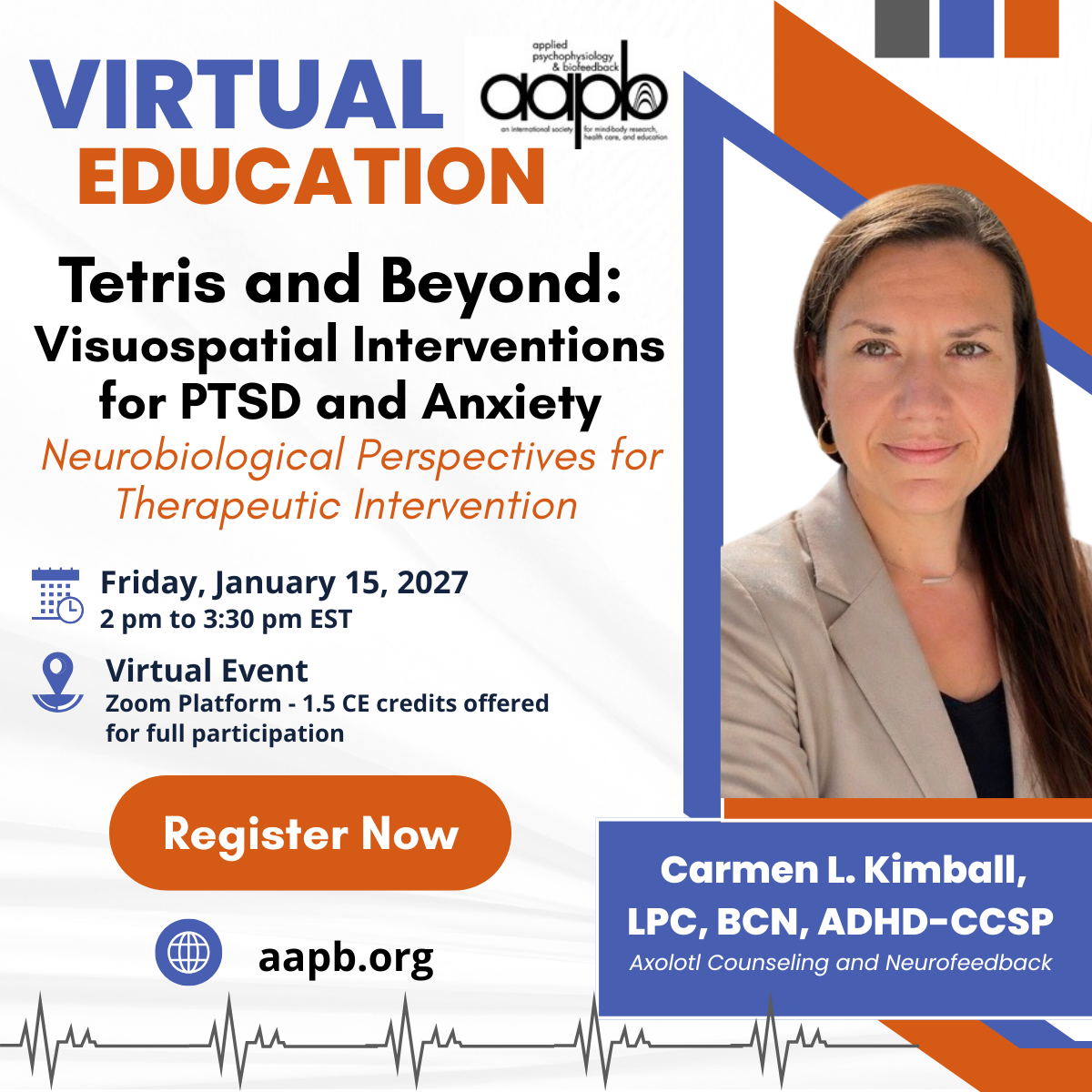
AAPB Virtual Education: Tetris and Beyond: Visuospatial Interventions for PTSD and Anxiety
What You'll Gain:
This session addresses the practice gap between emerging research on Tetris/visuospatial tasks and clinicians’ ability to apply that evidence ethically, accurately, and without overstating its clinical utility. Participants will evaluate the current evidence, identify appropriate clinical uses and limitations, and integrate visuospatial tasks as adjunctive, symptom-focused tools that may support improved trauma- and anxiety-informed care.
Date/Time:
Friday, January 15, 2027
- 2:00 pm to 3:30 pm EST US
- 1:00 pm to 2:30 pm CST US
- 12:00 pm to 1:30 pm MST US
- 11:00 am to 12:30 pm PST US
About this Presentation
This workshop introduces healthcare professionals to the emerging use of Tetris and other visuospatial tasks as adjunctive interventions for PTSD, acute stress reactions, anxiety, and trauma-related intrusive imagery.
Participants will examine how intrusive visual memories and flashbacks differ from voluntary autobiographical recall, with attention to their sensory-perceptual, involuntary, and affect-laden qualities.
The workshop reviews neurobiological and cognitive mechanisms underpinning why visuospatial tasks may reduce the frequency, vividness, or emotional intensity of intrusive imagery. Key concepts include memory consolidation and reconsolidation, working memory interference, as well as the distinction between targeted visuospatial engagement and general distraction. Research on Tetris-style mental rotation, trauma-film paradigms, emergency department studies, and clinical applications with established PTSD and complex PTSD will be discussed, including the promise, limitations, mixed findings, and methodological concerns in the current evidence base.
Participants will learn how to incorporate these strategies into therapeutic and wellness counseling practice. Emphasis will be placed on using visuospatial tasks as adjunctive, symptom-focused tools rather than stand-alone treatments. Clinical applications may include psychoeducation, between-session coping plans, post-trigger imagery-competing tasks, and integration with established trauma-focused treatment plans. Practical considerations will include task selection, timing relative to intrusive image activation, client engagement, documentation, informed consent, and monitoring response.
The presentation will also address cautions related to dissociation, avoidance, compulsive coping behaviors, destabilization, visual and motor limitations, neurodivergence, cultural accessibility, and client preference. Through case-based discussion, participants will explore how to identify appropriate symptom targets, select feasible visuospatial tasks, and integrate these interventions in a trauma-informed, transparent, and ethically responsible manner.
Attendees will earn 1.5 CE credits for full participation.
Pricing
AAPB Member and Student Member Price: $55 through January 3, 2027; $70 after
Non-member Price: $85 through January 3, 2027; $110 after
Non-member Student Price: $60 through January 3, 2027; $70 after
About Our Presenter
Carmen L. Kimball, LPC, BCN, ADHD-CCSP, Axolotl Counseling and Neurofeedback
Carmen is a Licensed Professional Counselor, ADHD Certified Clinical Services Provider, and board-certified neurofeedback clinician specializing in disorders related to trauma, anxiety, and executive functioning. She has 15 years of experience in biology, 9 years in behavioral sciences, and 7 years in QEEG and neurofeedback. Carmen’s background includes Research with the PBNJ Lab at the Krasnow Institute, contributing to peer-reviewed publications on learning and memory. Carmen is a trauma-informed care advocate, certified by the Office for Victims of Crime to teach the neurobiology of trauma to healthcare, legal, and allied professionals. Through her private practice Axolotl Counseling and Neurofeedback, Carmen integrates therapeutic and wellness interventions to support positive change, physiological regulation, adaptive relational functioning, and peak performance. As a native Spanish speaker, Carmen offers services in Spanish and English, supporting clients with culturally attuned care. Her appreciation for music, travel, and art informs her curiosity, creativity, and connection to diverse human experiences.
Disclosure: Carmen has financial interest to disclose. She is an independent contractor for Successful Practitioner, providing educational and mentoring service for bio and neurofeedback practitioners. This presentation will be free of commercial bias.
Learning Objectives
As a result of this presentation, you will learn to:
- Describe the clinical role of intrusive visual memories, flashbacks, and trauma-related imagery in PTSD, acute stress reactions, and anxiety presentations
- Evaluate research on Tetris-style mental rotation and other visuospatial tasks, including trauma-film paradigms, emergency department applications, anxiety-focused interventions, and clinical research involving established PTSD, complex PTSD, and trauma-related intrusive imagery
- Differentiate proposed neurobiological and cognitive mechanisms of change, including memory consolidation, reconsolidation, working memory interference, visuospatial competition, and general distraction
- Apply ethical, culturally responsive, trauma-informed, and clinically appropriate strategies for integrating visuospatial tasks as adjunctive, symptom-focused interventions in counseling and wellness practice
Target Audience
Healthcare clinicians and students who provide services or are learning to provide services to those struggling with anxiety and or trauma
Focus
50% Clinicial/50% Research
Level
Intermediate
Content builds upon the learner's foundational knowledge, familiarity with the literature and/or experience in a content area. Programming at this level includes more depth than at a beginning level program. It could also serve as a refresher course for individuals who have a background in a content area and are interested in learning more contemporary applications.
For those psychologists using the modality of biofeedback and interested in efficacy, science, and latest clinical applications. This conference (1) presents research relevant to psychological practice, education, and science; (2) it is our intention to host an offering to help psychologists to keep up with the most current scientific evidence regarding assessment, intervention, and education; and (3) we believe that this program would allow psychologists to increase competencies in order to improve services to patients. This conference is IN NO WAY a substitute for the basic academic education and training needed for entry into the field of psychology.
Utility and Validity (Risks)
Materials that are included in this course may include interventions and modalities that are beyond the authorized practice of mental health professionals. As a licensed professional, you are responsible for reviewing the scope of practice, including activities that are defined in law as beyond the boundaries of practice in accordance with and in compliance with your profession’s standards.
The presentation discusses brief visuospatial/interference-based interventions using Tetris or similar tasks to reduce intrusive traumatic memories, trauma-related imagery, and anxiety-related intrusive or distressing visual material. Limitations include that much of the evidence comes from analogue trauma-film studies with healthy participants, small pilot trials, or proof-of-concept studies, so findings should not be generalized as a stand-alone treatment for PTSD or anxiety disorders. Results are mixed: some studies show reduced intrusive memories, while others show no significant effect, suggesting boundary conditions are not fully understood.
No severe risks were identified in the reviewed content, but possible risks include temporary distress when recalling trauma- or anxiety-related material, increased attention to intrusive memories through diary tracking, avoidance of deeper trauma processing, and inappropriate use as a substitute for evidence-based treatment. The intervention should be presented as experimental or adjunctive, not as a replacement for trauma-focused therapy, anxiety treatment, clinical assessment, crisis care, or individualized treatment planning. Evidence includes randomized controlled trials, pilot studies, systematic reviews, and meta-analyses, with strongest support for reducing intrusive memories rather than treating full PTSD or anxiety disorders.
References
Asselbergs, J., van Bentum, J., Riper, H., Cuijpers, P., Holmes, E., & Sijbrandij, M. (2023). A systematic review and meta-analysis of the effect of cognitive interventions to prevent intrusive memories using the trauma film paradigm. Journal of Psychiatric Research, 159, 116–129. https://doi.org/10.1016/j.jpsychires.2023.01.028
Butler, O., Herr, K., Willmund, G., Gallinat, J., Kühn, S., & Zimmermann, P. (2020). Trauma, treatment and Tetris: Video gaming increases hippocampal volume in male patients with combat-related posttraumatic stress disorder. Journal of Psychiatry & Neuroscience, 45(4), 279–287. https://doi.org/10.1503/jpn.190027
Hagenaars, M. A., Holmes, E. A., Klaassen, F., & Elzinga, B. (2017). Tetris and Word games lead to fewer intrusive memories when applied several days after analogue trauma. European Journal of Psychotraumatology, 8(sup1), Article 1386959. https://doi.org/10.1080/20008198.2017.1386959
Iyadurai, L., Blackwell, S. E., Meiser-Stedman, R., Watson, P. C., Bonsall, M. B., Geddes, J. R., Nobre, A. C., & Holmes, E. A. (2018). Preventing intrusive memories after trauma via a brief intervention involving Tetris computer game play in the emergency department: A proof-of-concept randomized controlled trial. Molecular Psychiatry, 23(3), 674–682. https://doi.org/10.1038/mp.2017.23
Kehyayan, A., Thiel, J. P., Unterberg, K., Salja, V., Meyer-Wehrmann, S., Holmes, E. A., Matura, J.-M., Dieris-Hirche, J., Timmesfeld, N., Herpertz, S., Axmacher, N., & Kessler, H. (2024). The effect of a visuospatial interference intervention on posttraumatic intrusions: A cross-over randomized controlled trial. European Journal of Psychotraumatology, 15(1), Article 2331402. https://doi.org/10.1080/20008066.2024.2331402
Continuing Education Statement
 Psychologists: The Association for Applied Psychophysiology and Biofeedback is approved by the American Psychological Association to sponsor continuing education for psychologists. The Association for Applied Psychophysiology and Biofeedback maintains responsibility for the program and its content.
This virtual workshop offers a MAXIMUM of 1.5 CE credits for maximum participation.
BCIA Recertification: Hour-for-hour attendance may be used to fulfill the continuing education requirements for recertification with certificate of attendance.
About Continuing Education:
Coverage & Reciprocity
Psychologists (APA) Coverage & Reciprocity
The following state boards accept courses from APA providers for Counselors: AK, AL, AR, AZ, CA, CO, CT, DC, DE, FL, GA, HI, IA, ID, IL, IN, KS, KY, MD, ME, MO, NC, ND, NH, NE, NJ, NM, NV, OK*, OR, PA, RI, SC, SD, TN, TX, UT, VA, WI, WY
MI: No CE requirements
The following state boards accept courses from APA providers for MFTs: AK, AR, AZ, CA, CO, CT, DE, FL, GA, IA, ID, IN, KS, MD, ME, MO, NE, NC, NH, NJ, NM, NV, OK*, OR, PA, RI, SC, SD, TN, TX, UT, VA, WA, WI, WY
The following state boards accept courses from APA providers for Addictions Professionals: AK, AR, CO, CT, DC, DE, GA, IA, IN, KS, LA, MD, MO, MT, NC, ND, NE, NJ, NM, NY (outstate held), OK*, OR, SC, UT, WA, WI, WY
* OK accepts APA credit for live, in-person activities. For all ethics and/or online courses, an application is required.
MA / MFTs: Participants can self-submit courses not approved by the MAMFT board for review.
The following state boards accept courses from APA providers for Social Workers: AK, AR, AZ, CA, CO, DE, FL, GA, ID, IN, KY, ME, MN, MO, NE, NH, NM, OR, PA, VT, WI, WY
IMPORTANT NOTICE: Those who attend this event in full and complete the appropriate evaluation form will receive CE credits. Those arriving more than 15 minutes after the start time or leaving before a given activity is completed will not receive CE credit.
Cancellation Policy: Cancellations received by the AAPB office by ten days prior to event will be refunded minus a $25 processing fee. NO REFUNDS WILL BE GRANTED WITHIN TEN DAYS of the event. Cancellations must be made in writing and emailed to [email protected]. Fees cannot be refunded for registrations cancelled after the presentation begins.
Grievance Policy: The Association of Applied Psychophysiology and Biofeedback (AAPB) is fully committed to conducting all activities in strict conformance with the American Psychological Association's Ethical Principles of Psychologists. AAPB will comply with all legal and ethical responsibilities to be non-discriminatory in promotional activities, program content and in the treatment of program participants. The monitoring and assessment of compliance with these standards will be the responsibility of the Education Chair in consultation with the members of the continuing education committee, the AAPB Ethics Chairperson, Continuing Education (CE) Committee Chairperson, Program Planning Committee Chairperson, and/or the Conference Chairperson. While AAPB goes to great lengths to assure fair treatment for all participants and attempts to anticipate problems, there will be occasional issues which come to the attention of the convention staff which require intervention and/or action on the part of the convention staff or an officer of AAPB. This procedural description serves as a guideline for handling such grievances. 1. When a participant, either orally or in written format, files a grievance and expects action on the complaint, the following actions will be taken. If the person toward whom the grievance is directed is also the instructor or a chair of any of the above-mentioned committees, the AAPB Board of Directors will appoint a Board representative to oversee the resolution of any of the participant complaints, in an effort to avoid any and all conflicts of interest. If the grievance concerns a speaker, the content presented by the speaker, or the style of presentation, the individual filing the grievance will be asked to put his/her comments in written format. The CE Chair will then pass on the comments to the speaker, assuring the confidentiality of the grieved individual. 2. If the grievance concerns a workshop offering, its content, level of presentation, or the facilities in which the workshop was offered, the convention chair will mediate and will be the final arbitrator. If the participant requests action, the convention chair will: a) attempt to move the participant to another workshop or b) provide a credit for a subsequent year's workshop or c) provide a partial or full refund of the workshop fee. Actions 2b and 2c will require a written note, documenting the grievance, for record keeping purposes. The note need not be signed by the grieved individual. 3. If the grievance concerns an AAPB CE program, in a specific regard, the CE Chair will attempt to arbitrate.
Contact name(s)*: Leslie Shivers, AAPB Executive Director
Email: [email protected]
Telephone: 800-477-8892 or +1 303-422-8436
Address: PO Box 461797, Aurora, CO 80046-1797
Register NowTickets
$55.00 Member ticket
$70.00 after 12:00 am January 4
$85.00 Non-member ticket
$110.00 after 12:00 am January 4
$60.00 Non-Member Student Ticket
$70.00 after 12:00 am January 4
