Meeting/Event Information
AAPB Virtual Education: Respiratory Biofeedback in COPD: Brain–Breath Mechanisms and Clinical Outcomes
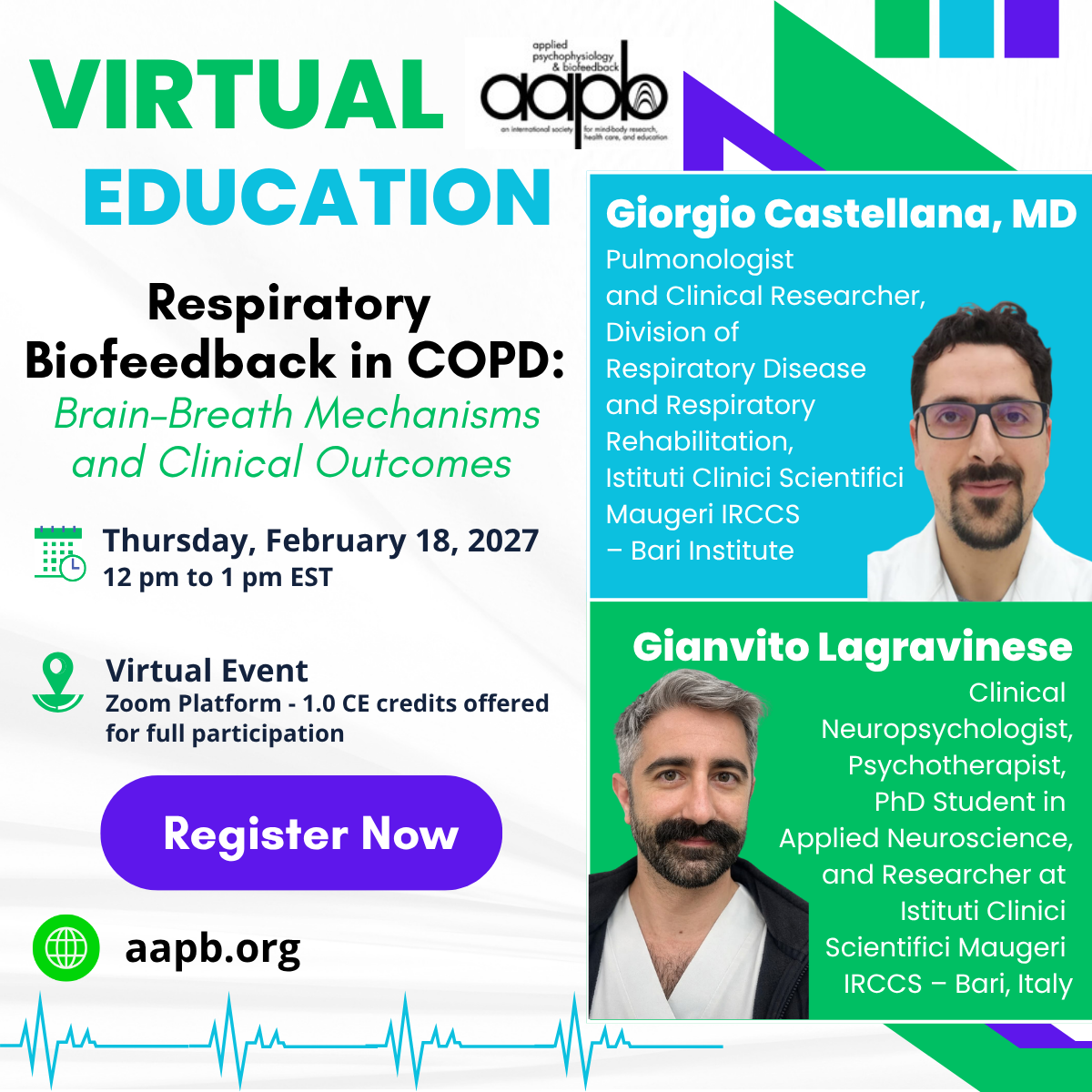
Thursday, February 18, 2027
- 12:00 pm to 1:00 pm EST
- 11:00 am to 12:00 pm CST
- 10:00 am to 11:00 am MST
- 9:00 am to 10:00 am PST
About this Presentation
Chronic obstructive pulmonary disease (COPD) is associated not only with airflow limitation and dyspnea but also with cognitive and affective difficulties that may influence rehabilitation. This session examines respiratory biofeedback within a brain–breath framework, integrating respiratory physiology, interoceptive processing, electroencephalography (EEG), and clinical rehabilitation.
First, current evidence on EEG correlates of cognitive vulnerability in chronic respiratory disorders will be summarized. Across 44 studies, recurrent findings included prolonged event-related potential latencies, altered sleep microstructure, and resting-state EEG slowing, most consistently associated with attention, executive, working-memory, and memory-consolidation difficulties. Second, dyspnea will be discussed as a multidimensional perceptual experience shaped by respiratory load, afferent feedback, corollary discharge, expectations, affective salience, and perceived control.
The clinical component will present a randomized pilot trial of respiratory biofeedback added to inpatient pulmonary rehabilitation in patients with very severe COPD. The intervention comprised 15 supervised sessions using abdominal respiratory sensors, blood volume pulse monitoring, and real-time visual and auditory feedback to support slower, more regular diaphragmatic breathing. Both groups improved in respiratory and functional outcomes; adjunctive biofeedback was associated with greater gains in global cognition and depressive symptoms, although it did not outperform standard rehabilitation for dyspnea or physical performance.
The session will conclude with practical considerations for patient selection, protocol delivery, safety, outcome assessment, and interpretation of findings, while distinguishing established evidence from emerging hypotheses. Neurofeedback will be discussed as a future translational research direction rather than an established treatment for dyspnea.
Attendees will earn 1.0 CE credits for full participation.
Pricing
- AAPB Member and Student Member Price: $65 through February 8; $75 after
- Non-member Price: $95 through February 8; $120 after
- Non-member Student Price: $70 through February 8; $80 after
About Our Presenters

Giorgio Castellana, MD - Pulmonologist, Medical Doctor and Clinical Researcher, Division of Respiratory Disease and Respiratory Rehabilitation, Istituti Clinici Scientifici Maugeri IRCCS – Bari Institute
Giorgio Castellana is a pulmonologist and clinical researcher at the Division of Respiratory Disease and Respiratory Rehabilitation, Istituti Clinici Scientifici Maugeri IRCCS, Bari, Italy. His clinical and research activities focus on chronic respiratory diseases, pulmonary rehabilitation, dyspnea assessment, and multidisciplinary interventions for patients with chronic obstructive pulmonary disease. He has contributed to clinical and translational studies examining respiratory biofeedback, cognitive and emotional outcomes in severe COPD, electroencephalographic correlates of cognitive impairment in chronic respiratory disorders, and the integration of psychophysiological approaches into pulmonary rehabilitation.

Gianvito Lagravinese, Clinical Neuropsychologist, Psychotherapist, PhD Student in Applied Neuroscience, and Researcher at Istituti Clinici Scientifici Maugeri IRCCS – Bari, Italy
Gianvito Lagravinese is a clinical neuropsychologist, psychotherapist, and researcher at Istituti Clinici Scientifici Maugeri IRCCS in Bari, Italy, and a PhD student in Applied Neuroscience at the University of Bari. His clinical and research activities focus on neuropsychological assessment and rehabilitation in patients with stroke, brain tumors, multiple sclerosis, and other neurological disorders, as well as on applied psychophysiology in chronic respiratory disease. His work integrates cognitive rehabilitation, neurofeedback, respiratory biofeedback, quantitative EEG, and psychophysiological monitoring, with particular interest in brain–breath interactions, cognitive outcomes in COPD, and personalized neurorehabilitation.
Our presenters have no financial interests to disclose.
This presentation will be free of commercial bias.
CE Credits
1.0 CE credits available for full event participation. You must attend the full, live delivery of the presentation to qualify for CE Credits.
Learning Objectives
As a result of this presentation, you will learn to:
- Describe the main electroencephalographic patterns associated with cognitive vulnerability in chronic respiratory disorders and the cognitive domains most frequently involved
- Differentiate the sensory, affective, interoceptive, and neurophysiological mechanisms that contribute to the experience of dyspnea in chronic obstructive pulmonary disease
- Explain the clinical rationale for integrating respiratory biofeedback into pulmonary rehabilitation within a brain–breath framework
- Outline the main components of a supervised respiratory biofeedback protocol, including sensor placement, feedback modalities, breathing targets, session structure, and safety considerations
- Analyze the findings of a randomized pilot trial of respiratory biofeedback in severe chronic obstructive pulmonary disease and assess their implications for future clinical practice and research
Target Audience
This intermediate-level session is intended for psychologists, neuropsychologists, biofeedback and neurofeedback practitioners, physicians, respiratory and neurological rehabilitation professionals, and researchers interested in applied psychophysiology. It will be particularly relevant to clinicians working with chronic respiratory disease and to professionals seeking to understand how respiratory physiology, cognition, emotion, and brain activity can inform the assessment and delivery of respiratory biofeedback.
Focus
40% Clinicial / 60% Research
Level
Intermediate
Content builds upon the learner's foundational knowledge, familiarity with the literature and/or experience in a content area. Programming at this level includes more depth than at a beginning level program. It could also serve as a refresher course for individuals who have a background in a content area and are interested in learning more contemporary applications.
For those psychologists using the modality of biofeedback and interested in efficacy, science, and latest clinical applications. This conference (1) presents research relevant to psychological practice, education, and science; (2) it is our intention to host an offering to help psychologists to keep up with the most current scientific evidence regarding assessment, intervention, and education; and (3) we believe that this program would allow psychologists to increase competencies in order to improve services to patients. This conference is IN NO WAY a substitute for the basic academic education and training needed for entry into the field of psychology.
Utility and Validity (Risks)
Materials that are included in this course may include interventions and modalities that are beyond the authorized practice of mental health professionals. As a licensed professional, you are responsible for reviewing the scope of practice, including activities that are defined in law as beyond the boundaries of practice in accordance with and in compliance with your profession’s standards.
Respiratory biofeedback is generally considered a low-risk, non-invasive intervention when delivered by appropriately trained professionals. In patients with severe chronic obstructive pulmonary disease, possible adverse responses include transient fatigue, increased dyspnea, anxiety, dizziness related to overbreathing, and oxygen desaturation. Sessions should therefore be individually paced, continuously supervised, and paused or rescheduled if symptoms worsen. In the pilot trial presented, no serious intervention-related adverse events were reported, and treatment was adapted according to each patient’s clinical tolerance.
The evidence is preliminary. The principal clinical study was a small, single-center randomized pilot trial involving hospitalized patients with very severe COPD. Respiratory biofeedback did not provide additional benefits over standard pulmonary rehabilitation for dyspnea or physical performance, although greater improvements were observed in global cognition and depressive symptoms. These results require replication in larger, multicenter studies and should not be generalized to all respiratory populations. The study was not designed to establish mechanisms of action. Neurofeedback will be presented only as a future research direction and not as an established treatment for dyspnea.
References
Lagravinese, G., Castellana, G., Genco, M., Guglielmo, M., Tagliente, S., Guido, P., Charitos, I. A., Aliani, M., Battista, P., Nese, M., & Carone, M. (2026). Respiratory biofeedback training as an adjunct intervention in pulmonary rehabilitation for late-stage COPD: A pilot trial. Applied Psychophysiology and Biofeedback. Advance online publication. https://doi.org/10.1007/s10484-025-09763-5
Lagravinese, G., Santacesaria, P., Castellana, G., Pasqualotto, F., Scaramuzzi, G. F., Manippa, V., Battista, P., Carone, M., & Taurisano, P. (2026). EEG patterns and cognitive outcomes in chronic respiratory disorders: A systematic review. Clinical Neurophysiology, 190, 2112316. https://doi.org/10.1016/j.clinph.2026.2112316
Lagravinese, G., Castellana, G., Pasqualotto, F., Carone, M., & Taurisano, P. (2026). Rethinking dyspnea in pulmonary rehabilitation: From respiratory load and interoceptive processing to biofeedback and neurofeedback. Frontiers in Rehabilitation Sciences, 7, 1844949. https://doi.org/10.3389/fresc.2026.1844949
de Souto Barbosa, J. V., do Nascimento Sales Figueiredo Fernandes, A. T., da Silva, J. L., da Silva Leal, L., de Aquino Santos, M. L. B., de Albuquerque Cacique New York, B. S., de Souza Lima, J. M., & Costa Leite, J. (2023). Effectiveness of paced breathing guided by biofeedback on clinical and functional outcomes patients with chronic obstructive pulmonary disease: An uncontrolled pilot study. Applied Psychophysiology and Biofeedback, 48(4), 423–432. https://doi.org/10.1007/s10484-023-09591-5
Wu, D.-W., Yang, P.-C., & Lin, I.-M. (2025). Effects of heart rate variability biofeedback in pulmonary indicators and heart rate variability indices among patients with chronic obstructive pulmonary disease. Applied Psychophysiology and Biofeedback, 50(3), 383– 394. https://doi.org/10.1007/s10484-024-09664-z
Continuing Education Statement
Psychologists: The Association for Applied Psychophysiology and Biofeedback is approved by the American Psychological Association to sponsor continuing education for psychologists. The Association for Applied Psychophysiology and Biofeedback maintains responsibility for the program and its content.
This virtual workshop offers a MAXIMUM of 1.0 CE credits for maximum participation.
BCIA Recertification: Hour-for-hour attendance may be used to fulfill the continuing education requirements for recertification with certificate of attendance.
About Continuing Education: Coverage & Reciprocity
Psychologists (APA) Coverage & Reciprocity
The following state boards accept courses from APA providers for Counselors: AK, AL, AR, AZ, CA, CO, CT, DC, DE, FL, GA, HI, IA, ID, IL, IN, KS, KY, MD, ME, MO, NC, ND, NH, NE, NJ, NM, NV, OK*, OR, PA, RI, SC, SD, TN, TX, UT, VA, WI, WY
MI: No CE requirements
The following state boards accept courses from APA providers for MFTs: AK, AR, AZ, CA, CO, CT, DE, FL, GA, IA, ID, IN, KS, MD, ME, MO, NE, NC, NH, NJ, NM, NV, OK*, OR, PA, RI, SC, SD, TN, TX, UT, VA, WA, WI, WY
The following state boards accept courses from APA providers for Addictions Professionals: AK, AR, CO, CT, DC, DE, GA, IA, IN, KS, LA, MD, MO, MT, NC, ND, NE, NJ, NM, NY (outstate held), OK*, OR, SC, UT, WA, WI, WY
* OK accepts APA credit for live, in-person activities. For all ethics and/or online courses, an application is required.
MA / MFTs: Participants can self-submit courses not approved by the MAMFT board for review.
The following state boards accept courses from APA providers for Social Workers: AK, AR, AZ, CA, CO, DE, FL, GA, ID, IN, KY, ME, MN, MO, NE, NH, NM, OR, PA, VT, WI, WY
IMPORTANT NOTICE: Those who attend this event in full and complete the appropriate evaluation form will receive CE credits. Those arriving more than 15 minutes after the start time or leaving before a given activity is completed will not receive CE credit.
Cancellation Policy: Cancellations received by the AAPB office by ten days prior to event will be refunded minus a $25 processing fee. NO REFUNDS WILL BE GRANTED WITHIN TEN DAYS of the event. Cancellations must be made in writing and emailed to [email protected]. Fees cannot be refunded for registrations cancelled after the presentation begins.
Grievance Policy: The Association of Applied Psychophysiology and Biofeedback (AAPB) is fully committed to conducting all activities in strict conformance with the American Psychological Association's Ethical Principles of Psychologists. AAPB will comply with all legal and ethical responsibilities to be non-discriminatory in promotional activities, program content and in the treatment of program participants. The monitoring and assessment of compliance with these standards will be the responsibility of the Education Chair in consultation with the members of the continuing education committee, the AAPB Ethics Chairperson, Continuing Education (CE) Committee Chairperson, Program Planning Committee Chairperson, and/or the Conference Chairperson. While AAPB goes to great lengths to assure fair treatment for all participants and attempts to anticipate problems, there will be occasional issues which come to the attention of the convention staff which require intervention and/or action on the part of the convention staff or an officer of AAPB. This procedural description serves as a guideline for handling such grievances. 1. When a participant, either orally or in written format, files a grievance and expects action on the complaint, the following actions will be taken. If the person toward whom the grievance is directed is also the instructor or a chair of any of the above-mentioned committees, the AAPB Board of Directors will appoint a Board representative to oversee the resolution of any of the participant complaints, in an effort to avoid any and all conflicts of interest. If the grievance concerns a speaker, the content presented by the speaker, or the style of presentation, the individual filing the grievance will be asked to put his/her comments in written format. The CE Chair will then pass on the comments to the speaker, assuring the confidentiality of the grieved individual. 2. If the grievance concerns a workshop offering, its content, level of presentation, or the facilities in which the workshop was offered, the convention chair will mediate and will be the final arbitrator. If the participant requests action, the convention chair will: a) attempt to move the participant to another workshop or b) provide a credit for a subsequent year's workshop or c) provide a partial or full refund of the workshop fee. Actions 2b and 2c will require a written note, documenting the grievance, for record keeping purposes. The note need not be signed by the grieved individual. 3. If the grievance concerns an AAPB CE program, in a specific regard, the CE Chair will attempt to arbitrate.
Contact name(s)*: Leslie Shivers, AAPB Executive Director
Email: [email protected]
Telephone: 800-477-8892 or +1 303-422-8436
Address: PO Box 461797, Aurora, CO 80046-1797
Tickets
$65.00 Member ticket
$75.00 after 11:59 pm February 8
$95.00 Non-member ticket
$120.00 after 11:59 pm February 8
$70.00 Non-Member Student Ticket
$80.00 after 11:59 pm February 8
