
Meeting/Event Information
AAPB Virtual Education: Novelty or Evidence? Virtual Reality in Biofeedback and Neurofeedback
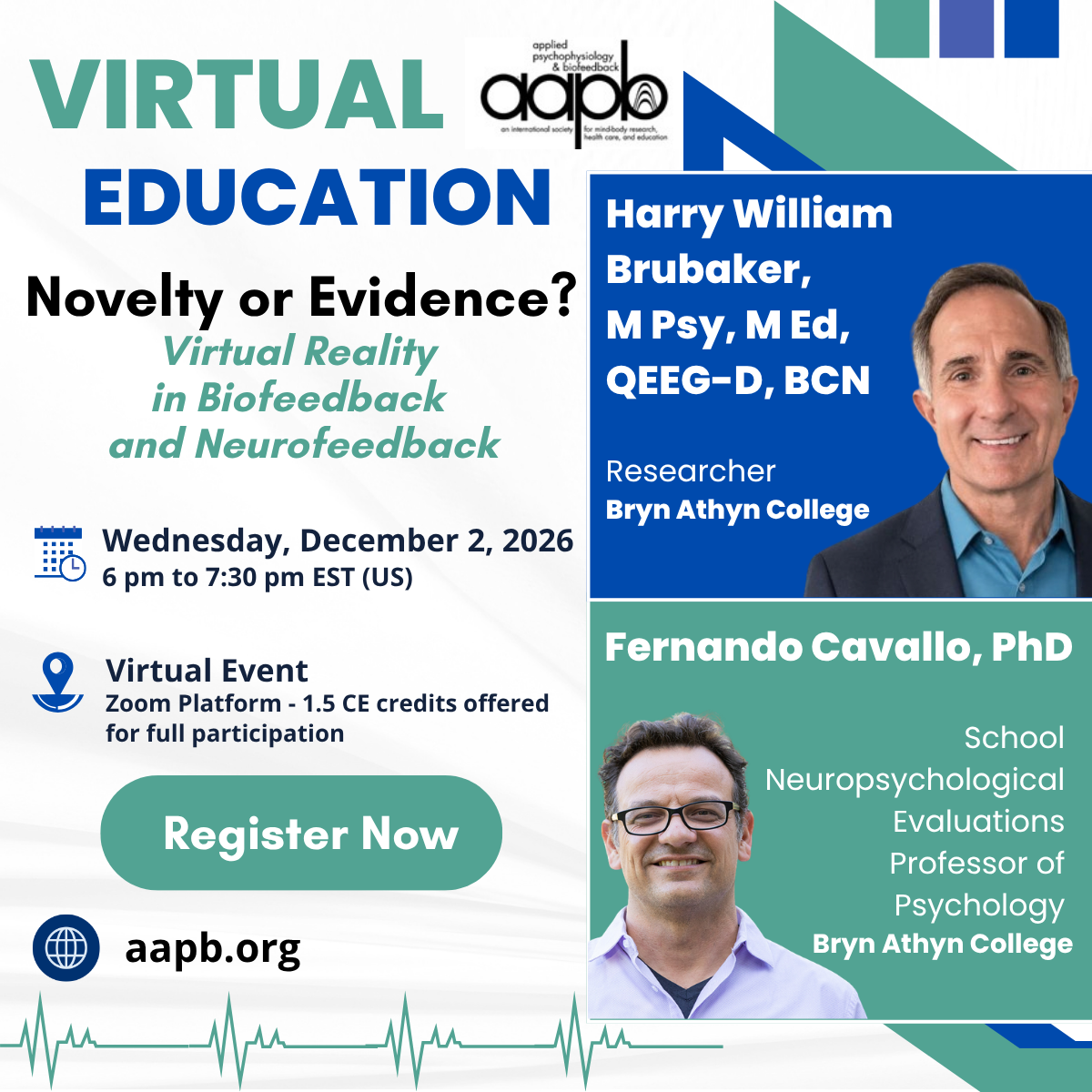
Wednesday, December 2, 2026
- 6:00 pm to 7:30 pm EST
- 5:00 pm to 6:30 pm CST
- 4:00 pm to 5:30 pm MST
- 3:00 pm to 4:30 pm PST
About this Presentation
Virtual reality (VR) is entering biofeedback (BFB) and neurofeedback (NFB) practice faster than its physiological evidence. This session asks whether VR adds clinical value beyond novelty, drawing on our own data and the wider literature. First, a published study shows that a VR head-mounted display can be worn over a 19-channel electrode cap with minimal, site-specific changes in quantitative electroencephalography (qEEG), supporting qEEG recording through the headset when fit is standardized. Second, our presenters review a published single-case study in which 25 home sessions of VR-guided meditation were accompanied by reduced anxiety ratings and decreased frontal high-beta activity in an adolescent with generalized anxiety, and discuss "beta shunting," our working hypothesis that immersion lowers fast-frequency activity by reducing external distraction. Third, the presenters summarize a submitted randomized study comparing VR with two-dimensional (2D) concussion education: both formats improved knowledge equally, while exploratory qEEG trends during viewing complicate the beta-shunting hypothesis. The presenters also share preliminary results combining photobiomodulation (PBM) with VR in adults with attention-deficit/hyperactivity disorder (ADHD).
Our presenters will then examine how VR can be paired with heart rate variability (HRV), respiration, surface electromyography (sEMG), electrodermal activity, and EEG-based NFB. Reviews report higher self-rated motivation and user experience, but no established physiological superiority over conventional displays. We explore restorative applications, including immersive nature scenes, the most common environments in VR-biofeedback studies, for stress reduction, paced breathing, and clients with limited access to natural settings. They will also describe BrainMaster Technologies' earlier 3D "Brain Room" visualization and why clinical uptake was limited.
Finally, because much of the missing evidence must come from clinical practice, our presenters provide a practical guide to single-case experimental designs for VR-biofeedback cases, and outline future directions, including closed-loop environments that respond to physiology in real time.
Attendees will earn 1.5 CE credits for full participation.
Pricing
AAPB Member and Student Member Price: $65 through November 18; $75 after
Non-member Price: $95 through November 18; $120 after
Non-member Student Price: $70 through November 18; $80 after
About Our Presenters
Harry William Brubaker, M Psy, M Ed, QEEG-D, BCN; Researcher, Bryn Athyn College
Harry W. Brubaker (Bill), a veteran and retired mathematics teacher, has been active in neurofeedback (NFB) since 2008. He holds BCN and QEEG-D certifications. Bill specialized in coherence training and served as lead therapist at the Autism Treatment Center of Newtown Square, PA, focusing on children and adolescents. Post-COVID, he consults for practitioners, psychologists and professors on QEEG and NFB education, and helped develop The Doering Research Center at Bryn Athyn College. His research includes co-authoring a Harvard/MIT-sponsored paper on Google Glasses for ASD, NIR therapy studies in Alzheimer's, and current projects on photobiomodulation for ADHD and virtual reality.
Disclosure: Bill has financial interest to disclose. He is a subcontractor for BrainMaster Technologies
Fernando Cavallo, PhD; School Neuropsychological Evaluations Professor of Psychology, Bryn Athyn College
Dr. Cavallo teaches upper level courses in Bryn Athyn’s Psychology program including Research Methods, Neuropsychology, Cognitive Psychology, and Psychological Tests & Measurements. His research interests include neuropsychology, neurofeedback, and neurocognitive interventions for Specific Learning Disabilities, ADHD, and Autism with recent research incorporating the use of Virtual Reality and Photobiomodulation as alternative treatment options. Dr. Cavallo earned his PhD in School Psychology from Temple University and has been supervising graduate students from Widener University’s clinical psychology program for the past 20 years. Dr. Cavallo has also served as a team leader for the BrainSTEPS program in Philadelphia, which provides consultative services in collaboration with the Children’s Hospital of Philadelphia to students returning to school following a concussion or traumatic brain injury. He also earned his diplomate from the American Board of School Neuropsychology. Dr. Cavallo has provided many professional presentations both locally and internationally to school staff and parents on various topics related to assessment, qEEG, special education, neurofeedback, and evidence-based interventions.
Disclosure: Dr. Cavallo has no financial interests to disclose.
This presentation will be free of commercial bias.
CE Credits
1.5 CE credits available for full event participation. You must attend the full, live delivery of the presentation to qualify for CE Credits.
Learning Objectives
As a result of this presentation, you will learn to:
- Describe the procedure for recording qEEG while a client wears a VR headset, and list the recording sites most affected by headset placement
- Explain the "beta shunting" hypothesis and critique it using the findings from the VR case study and the VR?versus-2D concussion education study
- Compare the published evidence for VR-based biofeedback and neurofeedback with conventional displays, distinguishing gains in self-rated engagement from established physiological or clinical superiority
- Identify ways to pair VR with HRV, respiration, sEMG, electrodermal, and EEG biofeedback, including the use of nature scenes for stress reduction and paced breathing
- Select a single-case experimental design (A-B, A-B-A-B, multiple baseline, or alternating treatments) suited to evaluating VR-biofeedback with an individual client
Target Audience
Clinicians and researchers who use or are considering virtual reality (VR) alongside biofeedback or neurofeedback, including psychologists, counselors, social workers, physical and occupational therapists, nurses, and physicians, as well as BCIA-certified practitioners, graduate students, and researchers. The session is introductory in level: familiarity with basic biofeedback or qEEG concepts is helpful but not required. Clinicians interested in documenting outcomes with single-case designs will find the methods section especially useful.
Focus
50% Clinicial / 50% Research
Level
INTRODUCTORY
Content is designed for psychologists who may have little to no background in a specialized skill or content area. Through this level of programming, the learner can become acquainted with the theoretical underpinnings, principles, methods, and perspectives of a content area. An introductory level program also may serve as the foundation for subsequent intermediate and advanced learning. Introductory level programming may also be related to an emerging area of knowledge or practice. Although this content can be used as a foundation for more advanced learning, an introductory level program may simply focus on breadth, enrichment or general knowledge.
For those psychologists using the modality of biofeedback and interested in efficacy, science, and latest clinical applications. This conference (1) presents research relevant to psychological practice, education, and science; (2) it is our intention to host an offering to help psychologists to keep up with the most current scientific evidence regarding assessment, intervention, and education; and (3) we believe that this program would allow psychologists to increase competencies in order to improve services to patients. This conference is IN NO WAY a substitute for the basic academic education and training needed for entry into the field of psychology.
Utility and Validity (Risks)
The evidence presented is preliminary: it comes from a small headset validation study, a single-case study without baseline phases, a small randomized study in which VR did not outperform 2D education, and an unpublished pilot combining photobiomodulation with VR. Published reviews show that clients rate VR-biofeedback as more motivating and enjoyable, but they do not establish that it is more effective than conventional biofeedback. qEEG differences observed during VR use were largely exploratory, and "beta shunting" is presented as a hypothesis rather than an established mechanism. The most common risk is cybersickness, including nausea, dizziness, headache, and eye strain, along with discomfort from wearing a headset over an electrode cap. Less common but more serious risks include falls or collisions while immersed, seizures in people with photosensitive epilepsy, temporary disorientation after use, and increased distress when anxiety-provoking content is used. Near-infrared light therapy requires eye protection and monitoring for skin heating. VR-biofeedback should therefore be considered an emerging intervention, and clinicians should screen for contraindications, use seated and time-limited sessions, and document outcomes with single-case methods.
Materials that are included in this course may include interventions and modalities that are beyond the authorized practice of mental health professionals. As a licensed professional, you are responsible for reviewing the scope of practice, including activities that are defined in law as beyond the boundaries of practice in accordance with and in compliance with your profession’s standards.
The presenters address how headset and electrode-cap fit vary with head size and hair type, a recognized barrier to EEG inclusion, and note that their 2023 study found headset-related qEEG changes in females but not males. We discuss how VR scenes, meditation scripts, and nature environments carry cultural assumptions about what is calming or appropriate, and how headset cost and technology access may widen disparities. Our own samples are small and drawn largely from US college and clinical settings, which limits generalization. They will present single-case designs partly because they center the individual client rather than assuming group averages apply across cultures, ages, and genders.
References
Lüddecke, R., & Felnhofer, A. (2022). Virtual reality biofeedback in health: A scoping review. Applied Psychophysiology and Biofeedback, 47(1), 1–15. https://doi.org/10.1007/s10484-021-09529-9
Cavallo, F., Brubaker, B., Bruckner, E., & Castro, S. (2023). A preliminary study investigating the acquisition of valid qEEG data while wearing a virtual reality (VR) headset. NeuroRegulation, 10(3), 170–178. https://doi.org/10.15540/nr.10.3.170
Cavallo, F., Campbell, F., Brubaker, H., & Smith, K. (2024). A case study utilizing virtual reality to reduce behavioral symptoms and brainwave activity related to anxiety. NeuroRegulation, 11(4), 379–393. https://doi.org/10.15540/nr.11.4.379
Gregory, J. C., Romero, D. E., & Jones, M. S. (2023). Exploring single-case research design with individualized anxiety-based neurofeedback protocols and session data. NeuroRegulation, 10(3), 159–169. https://doi.org/10.15540/nr.10.3.159
Kober, S. E., Wood, G., & Berger, L. M. (2025). Controlling virtual reality with brain signals: State of the art of using VR-based feedback in neurofeedback applications. Applied Psychophysiology and Biofeedback, 50(4), 593–612. https://doi.org/10.1007/s10484-024-09677-8
Kothgassner, O. D., Goreis, A., Bauda, I., Ziegenaus, A., Glenk, L. M., & Felnhofer, A. (2022). Virtual reality biofeedback interventions for treating anxiety: A systematic review, meta-analysis and future perspective. Wiener Klinische Wochenschrift, 134(Suppl. 1), 49–59. https://doi.org/10.1007/s00508-021-01991-z
Continuing Education Statement
 Psychologists: The Association for Applied Psychophysiology and Biofeedback is approved by the American Psychological Association to sponsor continuing education for psychologists. The Association for Applied Psychophysiology and Biofeedback maintains responsibility for the program and its content.
This virtual workshop offers a MAXIMUM of 1.5 CE credits for maximum participation.
BCIA Recertification: Hour-for-hour attendance may be used to fulfill the continuing education requirements for recertification with certificate of attendance.
About Continuing Education:
Coverage & Reciprocity
Psychologists (APA) Coverage & Reciprocity
The following state boards accept courses from APA providers for Counselors: AK, AL, AR, AZ, CA, CO, CT, DC, DE, FL, GA, HI, IA, ID, IL, IN, KS, KY, MD, ME, MO, NC, ND, NH, NE, NJ, NM, NV, OK*, OR, PA, RI, SC, SD, TN, TX, UT, VA, WI, WY
MI: No CE requirements
The following state boards accept courses from APA providers for MFTs: AK, AR, AZ, CA, CO, CT, DE, FL, GA, IA, ID, IN, KS, MD, ME, MO, NE, NC, NH, NJ, NM, NV, OK*, OR, PA, RI, SC, SD, TN, TX, UT, VA, WA, WI, WY
The following state boards accept courses from APA providers for Addictions Professionals: AK, AR, CO, CT, DC, DE, GA, IA, IN, KS, LA, MD, MO, MT, NC, ND, NE, NJ, NM, NY (outstate held), OK*, OR, SC, UT, WA, WI, WY
* OK accepts APA credit for live, in-person activities. For all ethics and/or online courses, an application is required.
MA / MFTs: Participants can self-submit courses not approved by the MAMFT board for review.
The following state boards accept courses from APA providers for Social Workers: AK, AR, AZ, CA, CO, DE, FL, GA, ID, IN, KY, ME, MN, MO, NE, NH, NM, OR, PA, VT, WI, WY
IMPORTANT NOTICE: Those who attend this event in full and complete the appropriate evaluation form will receive CE credits. Those arriving more than 15 minutes after the start time or leaving before a given activity is completed will not receive CE credit.
Cancellation Policy: Cancellations received by the AAPB office by ten days prior to event will be refunded minus a $25 processing fee. NO REFUNDS WILL BE GRANTED WITHIN TEN DAYS of the event. Cancellations must be made in writing and emailed to [email protected]. Fees cannot be refunded for registrations cancelled after the presentation begins.
Grievance Policy: The Association of Applied Psychophysiology and Biofeedback (AAPB) is fully committed to conducting all activities in strict conformance with the American Psychological Association's Ethical Principles of Psychologists. AAPB will comply with all legal and ethical responsibilities to be non-discriminatory in promotional activities, program content and in the treatment of program participants. The monitoring and assessment of compliance with these standards will be the responsibility of the Education Chair in consultation with the members of the continuing education committee, the AAPB Ethics Chairperson, Continuing Education (CE) Committee Chairperson, Program Planning Committee Chairperson, and/or the Conference Chairperson. While AAPB goes to great lengths to assure fair treatment for all participants and attempts to anticipate problems, there will be occasional issues which come to the attention of the convention staff which require intervention and/or action on the part of the convention staff or an officer of AAPB. This procedural description serves as a guideline for handling such grievances. 1. When a participant, either orally or in written format, files a grievance and expects action on the complaint, the following actions will be taken. If the person toward whom the grievance is directed is also the instructor or a chair of any of the above-mentioned committees, the AAPB Board of Directors will appoint a Board representative to oversee the resolution of any of the participant complaints, in an effort to avoid any and all conflicts of interest. If the grievance concerns a speaker, the content presented by the speaker, or the style of presentation, the individual filing the grievance will be asked to put his/her comments in written format. The CE Chair will then pass on the comments to the speaker, assuring the confidentiality of the grieved individual. 2. If the grievance concerns a workshop offering, its content, level of presentation, or the facilities in which the workshop was offered, the convention chair will mediate and will be the final arbitrator. If the participant requests action, the convention chair will: a) attempt to move the participant to another workshop or b) provide a credit for a subsequent year's workshop or c) provide a partial or full refund of the workshop fee. Actions 2b and 2c will require a written note, documenting the grievance, for record keeping purposes. The note need not be signed by the grieved individual. 3. If the grievance concerns an AAPB CE program, in a specific regard, the CE Chair will attempt to arbitrate.
Contact name(s)*: Leslie Shivers, AAPB Executive Director
Email: [email protected]
Telephone: 800-477-8892 or +1 303-422-8436
Address: PO Box 461797, Aurora, CO 80046-1797
Register NowTickets
$65.00 Member ticket
$75.00 after 11:59 pm November 18
$95.00 Non-member ticket
$120.00 after 11:59 pm November 18
$70.00 Non-Member student ticket
$80.00 after 11:59 pm November 18
